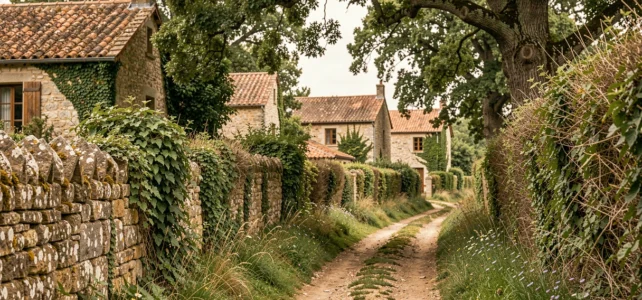
When browsing an IGN map or searching for an address in a rural municipality, one comes across terms that seem interchangeable: lieu-dit, hamlet, village. However, they designate distinct realities, with concrete consequences for postal addressing, urban planning rules, and the daily lives of residents.
Rural Addressing: What Has Changed Since the 3DS Law of 2022
Before delving into the definitions, one point deserves mention. Since the law n° 2022-217 of February 21, 2022 (known as the “3DS” law), all municipalities with fewer than 2,000 inhabitants must name their streets and number their buildings. This directly affects hamlets and lieux-dits, which could previously operate without street names or numbers.
On the ground, this obligation has sometimes led to the disappearance of hamlet names in favor of standardized street names. Feedback indicates that addresses are locally correct but absent from digital tools, particularly outside the village center. To understand the definition of a hamlet in France, one must first grasp that these distinctions are not merely historical: they still structure the administrative organization of the territory.
Lieu-dit: A Name for Land, Not a Group of Houses
The lieu-dit is the simplest of the three terms. It designates a named location on the cadastral map, linked to a geographical, historical, or agricultural feature. “La Croix Blanche,” “Les Quatre Chemins,” “Le Moulin Neuf”: these names identify a piece of territory.
A lieu-dit does not imply any habitation. It can refer to a field, a crossroads, or a wood. When houses are present, they carry the address of the lieu-dit, but it remains primarily a topographical marker.
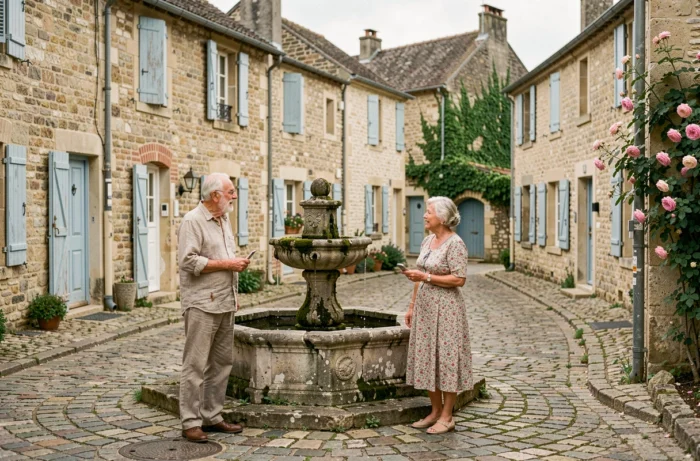
Have you ever received mail addressed to “Lieu-dit Le Pré Rond” without a street number? This is precisely the situation that the 3DS law seeks to correct. The lieu-dit served as a default address in the absence of a named street.
Inhabited Lieu-dit or Cadastral Lieu-dit
Sometimes, the inhabited lieu-dit (a few grouped houses) is distinguished from the cadastral lieu-dit (a simple parcel). The inhabited lieu-dit can become a hamlet when the number of constructions increases, but the boundary remains blurred.
Hamlet and Village: Size, Facilities, and Urban Planning Status
The hamlet refers to a small group of dwellings, isolated from the main village of the municipality. The Senate, in a response from 2007, characterizes it as a set of a maximum of ten to fifteen constructions. What defines it: a modest size and a physical grouping of buildings.
The hamlet does not require commerce, public services, or a church. It has no administrative life of its own. It is entirely dependent on the municipality to which it is attached.
The village, on the other hand, is distinguished by the presence (current or past) of collective facilities:
- A place of worship (church, parish chapel), even if disused
- Shops or public services, even if some have closed
- A more structured spatial organization, with an identifiable center (square, town hall, monument)
The village has or has had what the hamlet has never had: an autonomous collective life with shared facilities.
Why This Distinction Matters in Urban Planning
In urban planning documents (PLU, municipal map), the classification as a hamlet or village has direct effects on building rights. In mountainous areas, for example, urbanization can only occur in continuity with existing villages and towns. A hamlet does not automatically grant the right to extend urbanization around it.
Local elected officials must arbitrate: classifying a group of houses as a hamlet limits the possibilities for new construction. Classifying it as a village opens up more rights. The classification depends on local traditions, not on a fixed national threshold.
Municipality, Village, Agglomeration: Do Not Confuse the Scales
These three terms (lieu-dit, hamlet, village) do not overlap with the notion of municipality. A municipality is a territorial collectivity, the smallest administrative subdivision in France. It can contain both a main village, several hamlets, and numerous lieux-dits.
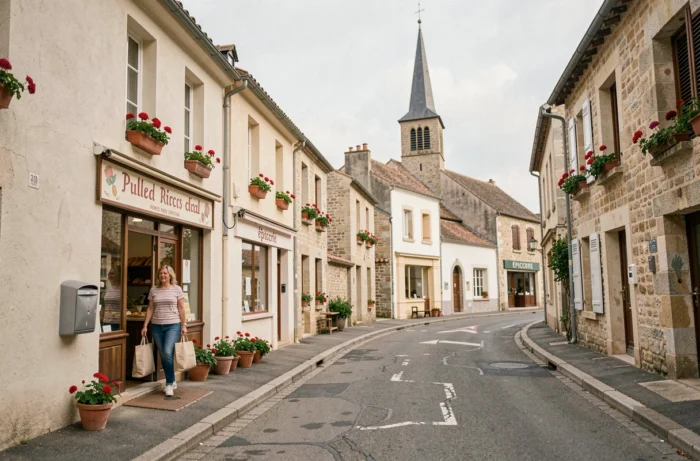
The village, historically, was distinguished from the hamlet by its market. Today, it designates the main center of a rural municipality, where the town hall, shops, and services are concentrated.
The agglomeration, in terms of urban planning law, refers to any urbanization larger than a village or of a different nature. The term does not only refer to large cities: a village can constitute an agglomeration in the legal sense.
To summarize the hierarchy:
- The lieu-dit names a place, inhabited or not
- The hamlet groups a few houses without collective facilities
- The village has facilities and its own way of life
- The village center is the main center of a rural municipality
- The municipality is the administrative entity that encompasses all of this
Rural Areas and INSEE Density Grid
INSEE classifies municipalities according to their population density. Rural municipalities correspond to areas of low or very low density. This classification does not directly use the terms hamlet or village, but it outlines their contours.
The least dense municipalities often house many dispersed hamlets, without a structured central village. In contrast, denser rural municipalities are organized around a main village with nearby services.
Population density remains the primary statistical criterion for distinguishing rural space from urban space in France. The notions of hamlet and village, however, fall under geographical and urban vocabulary, not statistics.
The next time you search for a gîte “in the hamlet of…” or read “lieu-dit” on a notarial deed, the distinction will have practical significance. Behind these words lie different building rights, recent addressing obligations, and an organization of rural territory that is far from trivial.