A self-sufficiency project is won or lost at the moment of choosing the land. The nature of the soil, the regulatory framework, and access to natural resources determine the viability of the installation for several decades. Here we address the technical points that most general public guides overlook.
ZAN constraint and buildability: what the PLU doesn’t yet say
The Climate and Resilience Law of 2021 established the principle of zero net artificialization (ZAN). The resulting administrative jurisprudence now makes it very unlikely for a non-buildable plot to be reclassified as buildable, even in rural areas.
In practical terms, a plot classified as A (agricultural) or N (natural) in the PLU has very little chance of being reclassified to zone U or AU during the next revision of the urban planning document. We recommend checking not only the current zoning but also the local development and sustainable development project (PADD) of the municipality, which indicates medium-term orientations.
For project holders considering a tiny house or light housing on a non-buildable plot, the possibilities remain constrained. The permanent installation of a removable residence requires a planning permit as soon as it exceeds a certain duration of annual occupation. Before signing a compromise, it is useful to find a plot on Immo Relax by filtering the parcels according to their actual zoning and easements.
A often overlooked point: wetlands identified by SAGE (water management and planning schemes) can render a plot classified as buildable in the PLU unbuildable. The Council of State recently confirmed the unbuildability of a plot located in a wetland, even when the PLU did not explicitly prohibit it.
Water autonomy: drilling, rainwater harvesting, and regulatory limits
The consumption of rainwater remains prohibited in France for drinking, cooking, and personal hygiene. This regulatory framework, updated by decree in 2024-2025, imposes a strict separation between the drinking water network and the rainwater network, with visible identification of pipes and protection against backflow.
Aiming for total water autonomy on an isolated plot is therefore a legal fantasy. The realistic goal is a semi-autonomy in water covering toilets, garden irrigation, and outdoor uses. For drinking water, a connection to the municipal network or a declared well remains necessary.
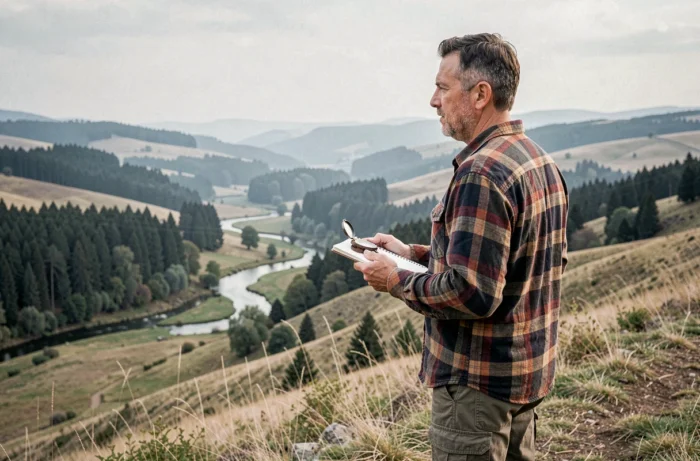
Any domestic drilling must be declared at the town hall at least one month before the start of work. Certain areas are completely prohibited for drilling, particularly protection zones for water catchments and classified sensitive aquifers. We observe that this criterion alone eliminates a significant portion of the plots offered in attractive areas for autonomy.
Hydrological criteria to check before purchase
- Presence of a spring, watercourse, or accessible aquifer on the plot or in the immediate vicinity, by consulting the piezometric map of the BRGM
- Possible classification in a water catchment protection zone (consultation of the SAGE and the departmental ARS)
- Local annual rainfall and realistic storage capacity to cover the needs of the garden and sanitation
- Soil nature (permeability, aquifer depth) to assess the technical feasibility and cost of drilling
Soil quality and the land’s food potential
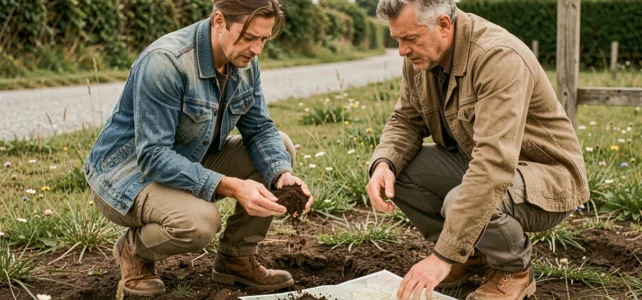
A plot intended for food self-sufficiency is judged not by its area but by the fertility of its soil. We recommend conducting a complete soil analysis (pH, organic matter content, CEC, trace elements) before any acquisition. The cost is modest compared to the risk of spending years correcting an unsuitable soil.
A deep loamy soil with a pH between 6 and 7 is suitable for most vegetable crops. Heavy clay soils require considerable amendment work. Sandy soils lose nutrients and irrigation water quickly.
The proximity of parcels in intensive conventional agriculture poses a risk of contamination from pesticide drift. Check the graphical parcel register (RPG) to identify neighboring crops. A plot enclosed between two treated corn parcels will be difficult to manage organically without a buffer hedge.
Assessing the energy potential of the plot
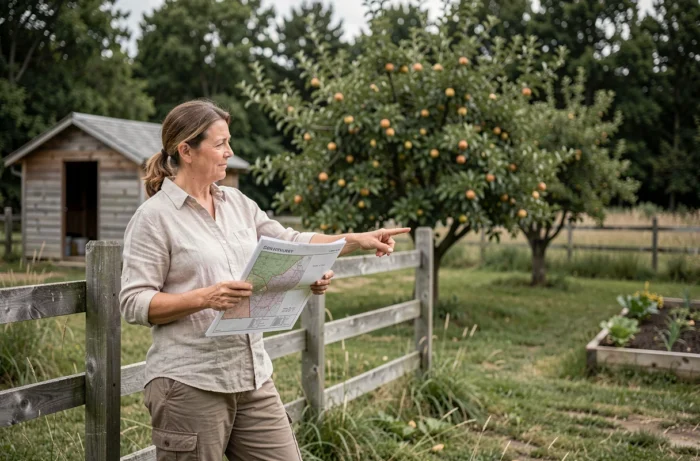
The orientation and solar shading affect both photovoltaic production and the bioclimatic potential of the habitat. A plot facing south with a clear horizon at less than 15 degrees elevation increases panel efficiency and reduces heating needs.
For wood energy, the presence of an adjacent forest plot or a communal right of wood collection radically changes the equation for autonomous heating. Wood remains the most accessible thermal energy source in isolated rural areas.
Land for living autonomously: contractual traps to anticipate
Passage easements, hunting rights, and precarious occupation agreements are rarely mentioned in listings. We find that the most isolated plots, those that attract self-sufficiency projects, often accumulate several easements that limit the actual use of the parcel.
- Passage easement benefiting a neighboring enclosed property, imposing permanent access through your land
- Public utility easement (power lines, pipelines) prohibiting any construction in a defined strip
- Ongoing rural lease on all or part of the plot, which may persist for several years after purchase
Always request the operational planning certificate (CUb), which is more comprehensive than the simple CUa. It specifies whether the land can be used for the proposed operation and lists applicable easements, taxes, and administrative limitations.
The choice of land for living autonomously relies less on a landscape crush than on a set of verifiable technical criteria. Soil, water, energy, urban planning: each parameter should be documented before signing. A well-qualified plot on these four axes offers a solid foundation for a long-term self-sufficiency project.