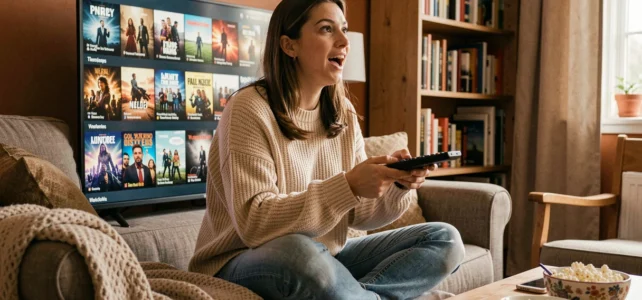
When you open three different applications in the evening to continue a series started the night before, you realize how fragmented the audiovisual landscape has become. Between the catalogs of Netflix, Prime Video, Disney+, and the schedules of free channels, keeping up with new TV series today requires a real monitoring method. The reflex of most French viewers now goes through a streaming platform even before checking the traditional TV program.
Streaming vs. Linear Television: Where to Watch Your Series in 2026
One might think that traditional television has lost the battle. The numbers tell a more nuanced story. According to an observatory cited by TV.fr and NR Magazine, 49% of French people first open a streaming platform to choose a series, compared to 45% who turn to free channels.
The shift of the first reflex towards SVOD does not mean that linear television is disappearing. The daily time spent in front of the television remains close to three hours, while SVOD platforms capture about 45 minutes per day. We watch Netflix to choose, but we stay on the couch in front of France 2 or TF1 for much longer.
To not miss anything in this dual flow, series news aggregators are becoming a daily sorting tool. On serielive.net, announcements of new seasons, broadcast dates, and episode summaries cover both the streaming catalog and the schedule of terrestrial channels, which avoids juggling between ten sources.

Netflix, Prime Video, Disney+: The Trio That Locks Down the French Market
The French streaming market is entering a visible phase of consolidation. Netflix, Prime Video, and Disney+ together represent about 61% of the French market according to the SVOD barometer for the first half of 2026 published by Le Mag Jeux High-Tech. Other players (Canal+, Apple TV+, HBO through partnerships, Arte.tv) share the rest.
Stabilization of Subscription Prices
After several years of regular increases, subscription prices are starting to stabilize, or even decrease for certain plans. The Streaming Observatory of TV.fr notes this trend towards rationalization: platforms are adjusting their offers rather than inflating prices.
For viewers, this stabilization changes the game. There is less hesitation to combine two subscriptions when the entry ticket remains reasonable. Feedback varies on this point among households, but the general trend is towards a balance of two or three platforms per household.
What This Means for Following Series
The consolidation of the market has a direct effect on series monitoring. When three platforms concentrate the majority of original productions, following their announcements already covers most of the new releases. The series to watch this fall illustrate this concentration well:
- Percy Jackson and the Olympians season 3, expected on November 20 on Disney+, continues the adaptation that has found its family audience
- Chad Powers season 2 with Glen Powell, available from September 3 on Disney+, rides the actor’s popularity after several successes in cinema
- Reacher continues to be among the most searched series on Prime Video, with a format of episodes tailored for binge-watching
Algorithmic Recommendations and European Rules: A Subtle but Concrete Change
We don’t really choose our series. In most cases, it’s the platform’s algorithm that suggests titles on the homepage. This mechanism is starting to evolve under the influence of European regulations, notably the Digital Markets Act (DMA) and the Digital Services Act (DSA).
The DMA requires large platforms not to systematically favor their own content to the detriment of third-party productions. Concretely, a series produced by a French independent studio should benefit from more equitable visibility in search results and suggestions.
The DSA, on the other hand, regulates the transparency of recommendation systems. Users should be able to understand why a series is suggested to them and potentially disable personalized profiling to access less filtered catalogs.

For series enthusiasts, these developments remain barely perceptible in daily life. Interface changes are made gradually. However, it is noted that some platforms now display categories like “trending in France” or “French productions” highlighted, where the homepage previously only showed in-house productions.
Media Chronology in France: When Do Films Arrive on Streaming
The media chronology directly conditions the catalog available on each platform. This French regulatory framework sets the deadlines between a film’s theatrical release and its availability on SVOD. Netflix can stream films approximately 17 months after their theatrical release, a timeline resulting from negotiations with the French film industry.
Amazon continues its discussions in 2026 to adjust its own streaming window, according to Le Figaro. These negotiations determine whether Prime Video can offer certain titles earlier than its competitors, a direct commercial lever.
This system does not exist in most other European countries, which explains why the French catalog of Netflix or Disney+ differs significantly from the American catalog. When searching for a recent film on the platform and it is not available, it is often the media chronology that explains it, not an oversight of the catalog.
Spoilers, Summaries, Trailers: Filtering Information Without Spoiling the Suspense
Keeping up with TV series news exposes one to a constant risk: stumbling upon a spoiler before having seen the episode. Specialized sites like Allociné or Télé 7 Jours usually flag risky content with a dedicated mention. On social media, no protection exists.
Some practical reflexes allow you to stay informed without having a plot spoiled:
- Favor sites that clearly separate summaries with spoilers from general announcements (dates, casting, renewals)
- Turn off notifications from discussion groups on the night an anticipated episode airs
- Check the “coming this week” sections rather than post-broadcast analyses when you are behind on a series
Arte regularly offers series available in full as soon as they are online, a format that eliminates the problem of weekly spoilers. This complete release model is gaining ground, including at Netflix which popularized it, even though Disney+ and Prime Video often prefer the pace of one episode per week to maintain online conversation.
The landscape of TV series in 2026 is structured around three dominant platforms, a linear television that retains its daily audience, and European rules that are beginning to redistribute content visibility. Keeping a single entry point to sort these flows remains the most reliable way not to miss a series that matches your tastes.