
Oxalis is one of the most tenacious weeds in the garden. Its underground bulbils and its ability to reseed explosively make any partial removal nearly useless. Since the extension of the Labbé law in 2019, individuals are no longer allowed to buy or use synthetic chemical herbicides, which significantly reduces the available arsenal. It remains to understand which solutions are actually approved, which work in the field, and why feedback varies so much from one gardener to another.
Oxalis Root System: Why Traditional Weeding Fails
The difficulty with oxalis does not lie in its clover-shaped leaves, but in what happens underground. The plant produces tiny bulbils, sometimes by the dozens around a mother plant, buried several centimeters deep. A simple hoeing breaks these storage organs and disperses them, worsening the infestation instead of containing it.
The seed capsules of oxalis burst at the slightest contact and project the seeds over a distance. Pulling without caution spreads the plant further. This ballistic mechanism explains why an apparently cleaned flowerbed becomes recolonized within a few weeks.
For anyone looking to treat oxalis with a herbicide, the first step is to admit that no product can reach all the buried bulbils in a single application. The underground structure of this weed requires repeated interventions, regardless of the method chosen.
Herbicides Allowed for Individuals: What the Labbé Law Leaves as Options
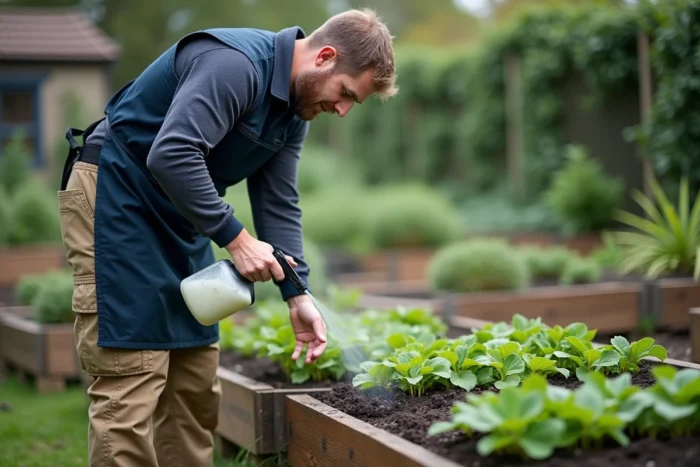
Since 2019, synthetic chemical herbicides are banned for purchase and use by amateur gardeners. This ban covers selective lawn herbicides as well as total herbicides based on glyphosate. The only products still accessible fall under biocontrol or specific formulations not classified as phytosanitary.
Herbicides Based on Pelargonic Acid
Pelargonic acid, a natural fatty acid, acts by contact, destroying the leaf cuticle. On oxalis, the effect is visible within a few hours: the aerial parts burn and dry out. The problem is that pelargonic acid has no systemic effect on the roots or bulbils. The plant regrows from its underground reserves within one to two weeks.
This type of product therefore requires repeated applications, spaced ten to fifteen days apart, throughout the entire active growing season. The goal is to gradually deplete the plant’s reserves, not to destroy it in one go.
Iron-Based Products on Lawns
Herbicides containing iron sulfate or chelated iron are sometimes presented as a selective solution for lawns. They cause the blackening and death of mosses and certain broadleaf dicotyledons. Field reports vary on their effectiveness against oxalis: some gardeners observe a temporary retreat, while others see no notable effect on regrowth.
The available data do not allow for a reliable conclusion regarding the effectiveness of these products on Oxalis corniculata or Oxalis pes-caprae, the two most common species in French gardens.
Mechanical and Preventive Methods Against Oxalis in Flowerbeds and Lawns
The generalization of alternative weeding techniques, accelerated by the ban on phytosanitary products in public spaces since 2017, has allowed for the documentation of approaches transferable to the family garden.
- Manual pulling in spring, before the formation of capsules, remains the most direct method. Each plant must be extracted with the surrounding clod of earth to recover the maximum number of bulbils, avoiding shaking the soil on site.
- Thick mulching (several centimeters of wood chips or straw) deprives seedlings of light and limits seed germination. A mulch applied in early spring and renewed in autumn significantly reduces the pressure of oxalis on flowerbeds.
- Installing a geotextile under the mulch strengthens the physical barrier, especially in paths or hedge bases where oxalis tends to establish itself first.
- False seeding, which involves preparing the soil and then allowing weeds to germinate before superficially destroying them, can trap some of the seed stock before planting.
None of these methods eliminate oxalis in one season. The combination of manual pulling in spring, permanent mulching, and regular monitoring yields the most consistent results over two to three years.
Thermal Weeding of Oxalis: Real Effectiveness and Limits
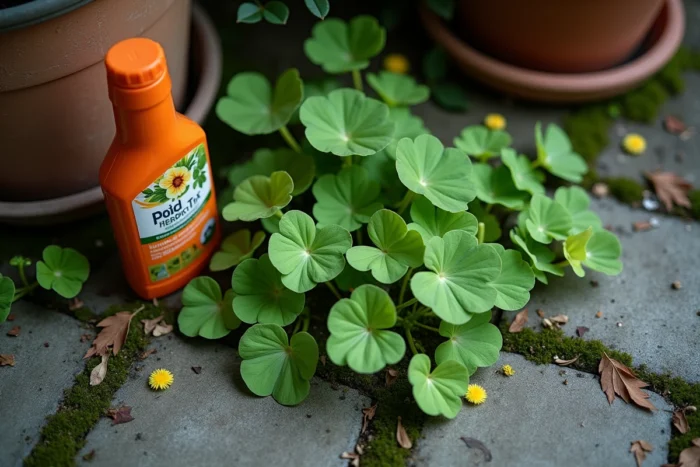
Thermal weeding (flame or boiling water) destroys the aerial parts of oxalis through thermal shock. On a bulbous weed, the effect is comparable to that of pelargonic acid: the visible part dies, but the plant regrows from its underground reserves.
The thermal application must be repeated every two to three weeks to hope for gradual depletion. On lawns, this technique is unusable without destroying the surrounding grass. It is more suited to paths, terraces, and non-grassed areas.
Boiling water has the advantage of slightly penetrating the soil and reaching some of the superficial roots. However, it also destroys the soil microfauna in the treated area, an effect rarely mentioned in gardening guides.
Oxalis in Lawns: Adapting the Strategy to the Type of Grass
In an established lawn, oxalis mainly settles in areas where the grass is sparse or weakened. A dense and well-nourished lawn constitutes the best barrier against oxalis. Mowing high (at least six to seven centimeters) promotes competition from the grass against creeping weeds.
Overseeding bare areas with a mix suitable for the exposure (shade or sun) limits the available spaces for colonization. Adding organic amendment in autumn strengthens the vigor of the grass without creating favorable conditions for oxalis, which prefers compact soils low in organic matter.
Excessive nitrogen fertilization, on the other hand, can benefit both oxalis and the grass. A balanced application remains preferable to a growth shock that does not last.
Managing oxalis in the garden relies on the combination of several levers, not on a single product. The authorized herbicides only act on the aerial parts, mechanical methods target the bulbils without guaranteeing completeness, and strengthening the plant cover plays a long-term role. Accepting a plan over two to three seasons changes the perspective: the goal is not total eradication but sustainable control of the pressure.