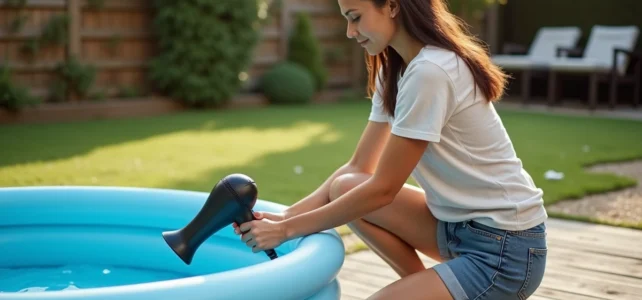
Inflating an inflatable pool with a hairdryer is a widely shared tip on social media. The method seems quick, practical, and accessible to everyone. However, considering the actual time savings, the risks to PVC, and the available alternatives, it’s worth evaluating the situation before plugging in the device.
Hairdryer vs. manual pump: a comparison of inflation time and constraints
The choice of inflation method depends on what you have on hand, the volume of the pool, and the time you are willing to spend. Here is a comparison of the main options for inflating an inflatable pool without a dedicated electric pump.
| Method | Estimated time (small children’s pool) | Physical effort | Risk to PVC |
|---|---|---|---|
| Blow by mouth | Long (several tens of minutes) | Very high | None |
| Hairdryer (cold air) | Several minutes | Low | Low if strictly cold air |
| Hairdryer (hot air) | Several minutes | Low | High (overheating, welds) |
| Trash bag used as a bellows | Moderate | Moderate | None |
| Foot or manual pump | Moderate | Moderate | None |
The hairdryer stands out for its speed. However, it introduces a variable absent from other methods: the temperature of the blown air. This parameter makes all the difference between an effective tip and a costly mistake.
To understand how to inflate a pool with a hairdryer without damaging the equipment, the main precaution can be summed up in one word: cold mode.
Hot air and aging of PVC: what manufacturers report
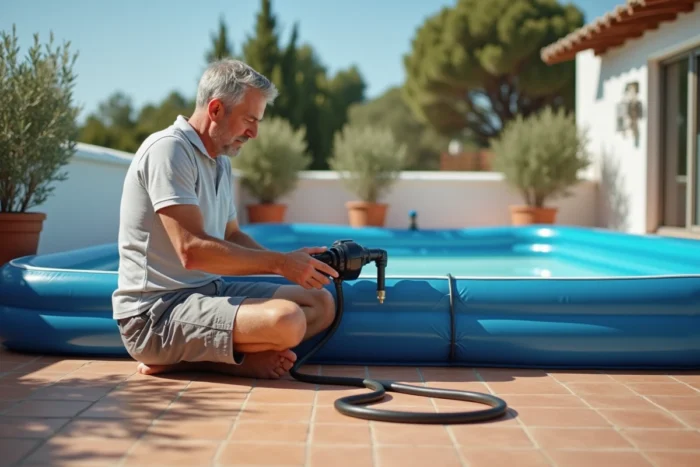
Several manufacturers of inflatable pools and spas classify the hairdryer among the non-compliant equipment that may void the warranty. The reason lies in the local overheating of PVC welds and the deformation of the tubes due to concentrated hot air.
Recent maintenance guides confirm this point. Hot air accelerates the aging of PVC by causing excessive initial expansion. Over two to three seasons of use, this repeated thermal stress promotes the appearance of micro-cracks and a loss of flexibility in the material.
This phenomenon is already well documented in poorly inflated inflatable spas or those exposed to excessively high inflation temperatures. The mechanism is identical for an inflatable pool: the weld areas, being thinner, poorly withstand abrupt thermal variations.
Why cold mode changes the game
A hairdryer set to cold air produces a sufficient airflow to inflate a modest-sized pool in a few minutes. The temperature remains close to the ambient air, eliminating the risk of deformation.
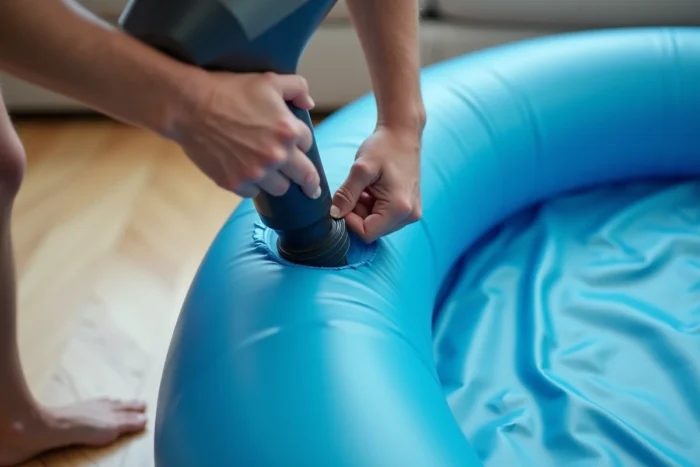
The technique involves pressing the hairdryer nozzle against the intake valve, creating as tight a seal as possible. Some users insert the neck of a cut plastic bottle to adapt the diameter. Airflow matters more than thermal power: a low-power device in cold mode is more than adequate for a children’s pool.
Inflation valve and sealing: a technical point often overlooked
The valve is the component that determines the success or failure of the operation. On most consumer inflatable pools, the valve is designed for a blower or manual pump, not for the wide, low-pressure flow of a hairdryer.
- Check valves allow air in but restrict flow if the pressure is too low, which prolongs inflation time
- Simple plug valves (without a check valve) are the most suitable: they accept a wide flow and close manually after inflation
- On double valve models (separate inflation and deflation), ensure that the deflation valve is properly closed before starting, or you risk inflating into a void
Adapting the nozzle to the valve diameter is the only step that requires a bit of DIY. A cone made of stiff cardboard or the neck of a PET bottle serves as an adapter. The goal is to reduce lateral air leaks so that the hairdryer’s airflow actually enters the tube.
Hairdryer noise and neighbors: an underestimated factor
Specialized content on the acoustic comfort of pool installations indicates that replacing a pump with a noisy improvised device can exceed acceptable noise thresholds for neighbors. This factor has already led to complaints about overly noisy pool pumps.
A high-powered hairdryer in prolonged operation produces a noise level comparable to that of a vacuum cleaner. In an outdoor setting, early in the morning or in the evening, this noise can become a source of friction. For a small children’s pool, inflation only lasts a few minutes, which limits the issue. For a family model with multiple tubes, the cumulative duration increases significantly.
Silent alternatives to the hairdryer
The technique of using a trash bag as a bellows produces no noise. The principle: open a large bag to fill it with air, then compress it against the open valve. Several cycles of the bag are sufficient for a standard-sized tube. This method takes a bit more time but requires neither electricity nor valve adaptation.
A foot pump remains the most balanced compromise between speed, silence, and safety for PVC. Its cost is modest, and it can also be used for mattresses, floats, and other inflatable equipment.
Inflation and water maintenance: two related topics for inflatable pools
Feedback shows that many inflatable pool owners focus on the inflation tip and neglect the minimal maintenance of the water. Without filtration or treatment, the water becomes unusable in less than 48 hours, especially in hot weather.
- A net to remove surface debris after each use
- An appropriate treatment for the volume (tablets or liquid) to maintain healthy water
- A cover tarp when the pool is not in use, to limit contamination and evaporation
The inflation method has no impact on water quality. However, a pool inflated in five minutes with a hairdryer and then filled without consideration for treatment ends up causing more problems than the inflation itself.
The hairdryer in cold mode remains a functional tip for small pools, provided the valve is adapted and the material limits are respected. For larger models, a dedicated pump avoids thermal constraints, noise, and the hassle of making an adapter, while preserving the manufacturer’s warranty.