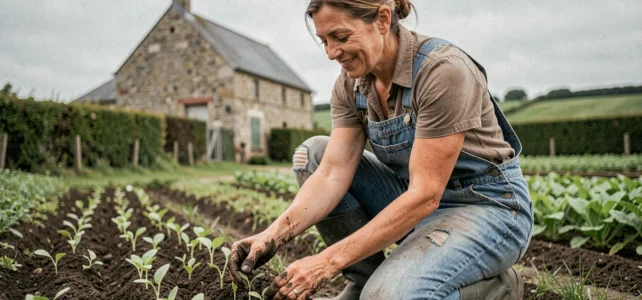
In France, agricultural land still covers a majority of the territory. The practices deployed there directly shape rural landscapes, water quality, and local biodiversity. Since the law of March 24, 2025, aimed at food sovereignty and generational renewal, several regulatory mechanisms have accelerated the transition to sustainable agriculture. These measures are concretely changing the daily lives of farms and the appearance of the French countryside.
Unique hedge protection scheme: what changes for farms
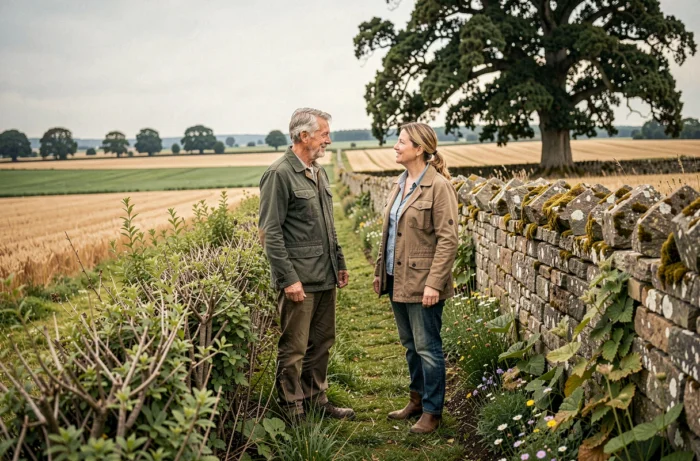
Have you noticed that some agricultural plots are bordered by dense hedges, while others are completely devoid of them? This visual contrast reflects decades of removal without compensation. The law of March 24, 2025, marked a turning point by establishing a unique declaration and instruction regime for any hedge destruction.
Specifically, a farmer wishing to remove a hedge must now go through a single administrative procedure, rather than navigating multiple overlapping regulations. An interministerial decree of April 3, 2026, established a national typology of hedges, classifying each type according to its ecological and landscape function.
The prefects then establish a compensation coefficient grid tailored to each territory. If an old hedge with high ecological value is destroyed, the required compensation will be higher than for a recent mono-specific hedge. This system encourages operators to integrate hedges as a structuring element of their land management, rather than as an obstacle to production.
Landscape and agriculture professionals are working together on these issues, as shown by the diversity of resources available at https://www.agriculture-et-paysage.fr/, which connects agricultural production challenges with landscape quality.

Agricultural climate resilience areas: adapting crops to the land
Climate change does not affect French territories in the same way. Mediterranean regions are experiencing prolonged droughts, while other areas face intense rainfall episodes. To address this diversity, the Mediterranean Agriculture Plan (PAM), deployed since 2024 and extended in 2026, introduced the labeling of climate resilience agricultural areas (AARC).
These areas are not just simple administrative zones. They bring together local authorities, natural parks, agricultural chambers, and industry stakeholders around a common goal: to co-develop local adaptation plans. Each AARC defines the crops and practices best suited to its pedoclimatic context.
How an AARC operates on a daily basis
A regional natural park identifies, with local farmers, drought-resistant varieties and crop rotations that preserve soil moisture. Agricultural chambers provide technical support. Local authorities finance part of the investments, particularly for water storage infrastructure or the planting of windbreak hedges.
This territorialized model avoids the pitfall of a uniform policy applied to very different geographical realities. It also allows for directly linking rural landscape management to climate adaptation strategy.
Agroecology and low-carbon label: concrete levers for sustainable transition
Agroecology is based on a simple principle: using natural processes (pollination, nitrogen cycle, ground cover) to reduce dependence on chemical inputs. The national strategic planning (PSN), which spans five years, confirms the reduction of inputs and the development of agroecological systems as structuring axes of French agricultural policy.
The low-carbon label applied to farms
Among the tools that materialize this orientation, the low-carbon label allows farms to financially value their efforts to reduce greenhouse gas emissions. A labeled project follows a precise protocol:
- Initial diagnosis of the farm’s emissions (livestock, crops, energy, transport)
- Multi-year action plan with measurable objectives (soil coverage, rotation diversification, reduction of synthetic nitrogen fertilizers)
- Verification by an independent third party and issuance of exchangeable carbon credits
Projects like Sysfarm in Centre-Val de Loire illustrate this approach. The low-carbon label transforms agronomic practices into economic assets, facilitating farmers’ adherence.
Payments for environmental services: compensating farmers for what they protect
The idea is straightforward: a farmer who maintains a wetland, protects a water catchment, or maintains a permanent meadow provides a service to the community. Payments for environmental services (PES) formalize this logic by providing compensation in exchange for verifiable practices.
Around Dinan, in Côtes-d’Armor, a PES scheme aims to preserve water resources. Farmers commit to limiting pesticide treatments on plots located upstream of catchments. In return, they receive an annual financial compensation.
Why PES changes the economic logic
In the classic model, a farmer is compensated only for their production (milk, grains, meat). PES adds a second revenue stream linked to the environmental quality of their practices. This dual compensation makes agronomic choices that would otherwise be seen as yield losses viable.
- Maintaining permanent meadows that store carbon and filter water
- Targeted reduction of inputs in sensitive areas (catchments, waterways)
- Planting and maintaining hedges or grassed strips along plots
- Diversifying crop rotations to limit soil erosion
These measures are not disguised subsidies. They are based on multi-year contracts with indicators of results measured on the ground.
The convergence between hedge protection, territorialized climate adaptation, low-carbon labeling, and payments for environmental services outlines a framework where sustainable management of agricultural land and the quality of rural landscapes become inseparable. Farms that engage in these measures do not just change their agronomic practices: they redefine their role in the territory.