
Connecting Paris to London by road is about 460 kilometers, but the actual travel time depends on variables that route calculators often underestimate: boarding time at the terminal, crossing the English Channel, cumulative tolls on the French side, and urban taxes on the English side. This article measures each segment of the journey and details the costs that add to fuel, from the exit of the Paris ring road to the center of London.
Time by segment: where the minutes are lost between Paris and London
| Segment | Distance | Estimated Duration |
|---|---|---|
| Paris – Calais (A1 then A26) | ~290 km | ~3 h |
| Check-in at LeShuttle terminal (Coquelles) | – | 30 to 60 min |
| Crossing Calais – Folkestone (tunnel) | 50 km | 35 min |
| Folkestone – central London (M20/M25) | ~120 km | 1 h 30 to 2 h |
| Total door-to-door | ~460 km | 5 h 30 to 6 h 30 |
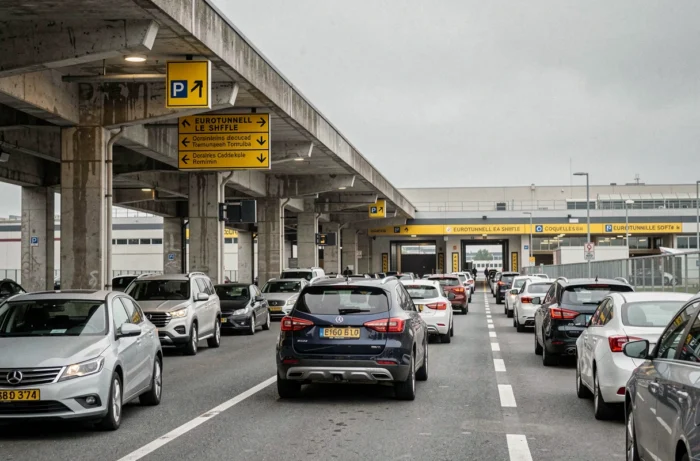
The Paris-Calais segment is the most predictable: smooth highway outside of major holiday weekends. The segment that disrupts schedules is boarding at the Coquelles terminal. Arriving 30 minutes before departure is a minimum, but checks at the British borders can extend the wait well beyond during the summer period.
On the English side, the Folkestone-London section varies greatly depending on the time of arrival. The M25 (London ring road) is congested between 7 a.m. and 9:30 a.m., and then again between 4:30 p.m. and 7 p.m. Planning to arrive in Folkestone mid-morning or early afternoon can easily save half an hour on this last segment.
Before booking a crossing, checking the practical details for driving to London from Paris helps anticipate customs procedures and the least busy time slots.
ULEZ and Congestion Charge: the real cost of a car in London
Most guides stop at the price of the tunnel or ferry. The expense that surprises French drivers kicks in once the car enters Greater London.
Two cumulative taxes for non-compliant vehicles
Since the extension in August 2023, the ULEZ (Ultra Low Emission Zone) covers all boroughs of London, 24/7. A vehicle that does not meet Euro 4 (petrol) or Euro 6 (diesel) standards pays £12.50 per day.
The Congestion Charge adds to this in the central zone: £18 per day if payment is made on the same day or in advance, £21 for late payment. It applies from 7 a.m. to 6 p.m. on weekdays and from 12 p.m. to 6 p.m. on weekends and public holidays.
For a non-compliant car driving during the day in the center, the daily cost exceeds £30, excluding parking. These two systems also apply to foreign plates and rental vehicles. Fines can be collected by European recovery agencies.
Check compliance before departure
- Petrol vehicles registered after 2006 generally meet Euro 4 standards. Diesel vehicles must be at least Euro 6, which roughly corresponds to models registered from September 2015 onwards.
- The official Transport for London website offers a verification tool (ULEZ checker) where you can enter your license plate, including French plates.
- If the vehicle is non-compliant, parking on the outskirts and taking public transport to the center is significantly cheaper than paying ULEZ every day.

Crossing the Channel: tunnel versus ferry, the differences that matter
The choice of crossing affects both the total duration and the budget. The two main options are the tunnel (LeShuttle, Coquelles terminal) and ferries departing from Calais or Dunkirk.
| Criterion | Tunnel (LeShuttle) | Ferry (Calais-Dover) |
|---|---|---|
| Crossing Duration | 35 min | About 1 h 30 |
| Frequency | Up to 4 departures/hour | Several per day |
| Time Flexibility | High (boarding for the next departure) | Reserved slot |
| Comfort during crossing | Stay in the car | Decks, restaurants, open air |
| Indicative Price | Variable depending on the season and booking | Generally cheaper with early booking |
The tunnel is about an hour faster overall (shorter crossing, smoother boarding). However, the ferry offers a real break during the journey, which can be appreciated after three hours of driving from Paris.
The price difference between the two depends heavily on the booking date. Booking several weeks in advance reduces the cost in both cases, but the ferry tends to offer lower rates in the low season.
Dartford Crossing and driving on the left: what changes on the English side
The Dartford Crossing, a must on the M25 east of London, is subject to a digital toll. No physical barrier indicates payment: cameras read the license plates, and the driver must pay online by midnight the following day. Forgetting this toll results in a fine that far exceeds the initial amount.
Driving on the left is particularly disorienting in roundabouts and when merging onto the highway. Two habits to adopt as soon as you reach Folkestone: look to the right first before entering, and stay in the left lane (the slowest) on multi-lane sections.
Parking in central London represents a separate budget. Underground car parks often charge by the hour, with rates that quickly rise in zone 1. Parking in zone 4 or 5 near a tube station is the most economical option for a stay of several days.
Overall, the Paris-London drive remains competitive for a group of three or four passengers, provided that the budget includes French tolls, the crossing, urban taxes, and parking. For a solo traveler, the cost-time ratio rarely favors the car over the Eurostar.