
Transporting a refrigerator on its side exposes its refrigeration circuit to oil displacement, which can compromise the compressor upon restart. The question of how long to wait before turning the appliance back on comes up consistently during a move or when purchasing a second-hand unit, and the answer depends on parameters that most guides treat too uniformly.
Compressor Oil and Transport on Its Side: What Happens in the Circuit
The compressor of a refrigerator operates thanks to a lubricating oil that normally remains confined to its lower part. When the appliance is tilted or laid down, this oil migrates into the conduits of the refrigeration circuit, particularly the capillaries that regulate the flow of refrigerant.
The issue is not the refrigerant itself, but rather the oil that clogs the capillaries if it does not have time to return. A compressor that starts without sufficient lubrication runs dry, which can irreversibly damage its internal components.
This mechanism explains why simply plugging in a fridge “just to see” poses a real risk. The severity depends on how long the appliance has been on its side and the side on which it was placed. In this regard, knowing how long to wait after laying a fridge down before turning it back on requires considering these two variables together, not separately.

Waiting Time Based on Position and Duration of Transport
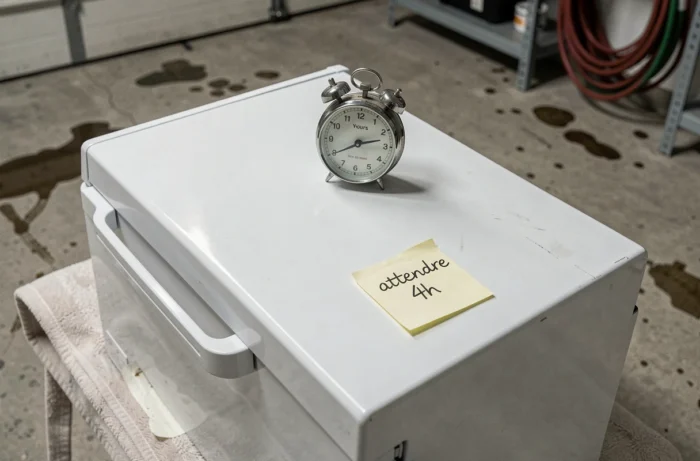
The generic advice to wait “a few hours” does not take into account a determining factor: the actual time spent lying down. Guidelines from GE Appliances specify that the standing rest time must at least equal the time spent lying down, with a maximum rest period set at about a full day for prolonged transports.
In practical terms, a fridge that has been laid down for thirty minutes during loading does not require the same waiting time as an appliance transported on its side for several hours on the highway.
The Side on Which the Fridge Was Laid Changes the Game
Not all refrigerators react the same way depending on the side of inclination. Some manufacturers place a sticker indicating the allowed transport side. When the appliance has been laid down on that side, the risk of oil migration into the capillaries remains moderate, and a rest period of about a day is generally sufficient.
On the other hand, if the fridge has been laid down on the opposite side to the one recommended, the oil can block the capillaries more deeply. In this case, field reports vary on the exact time, but a prolonged wait beyond the simple ratio of “time lying down = time standing” is recommended by several technicians.
- Fridge laid down on the side indicated by the manufacturer: standing rest of at least the same duration as the transport, up to a full day.
- Fridge laid down on the wrong side: prolonged rest, with some sources advising up to forty-eight hours for the most unfavorable cases.
- Fridge transported upright but heavily tilted: a rest of a few hours is sufficient in most situations.
Restarting the Refrigerator: Signals to Watch For
Once the resting time has elapsed, plugging it in does not mark the end of vigilance. The compressor needs several hours to reach its normal operating temperature. Placing food in the appliance too soon slows this cooling process and puts additional strain on the motor.
Waiting for the fridge to reach its target temperature before storing food protects both the cold chain and the compressor. This delay varies depending on the model and ambient temperature, but it typically takes several hours after plugging in.
Abnormal Noises at Startup
A compressor restarting after being transported on its side may emit gurgling noises during the first few minutes. This is the refrigerant resuming its normal circulation in the circuit. These sounds usually disappear fairly quickly.
A repetitive clicking noise or a compressor that stops and restarts in a loop over short periods indicates a different problem. A compressor that cycles continuously without cooling suggests that the oil has likely not returned to its position. In this case, unplugging the appliance and extending the standing rest time remains the best option before considering technical intervention.
New Fridge or Second-Hand Fridge: Does the Same Logic Apply?
A new refrigerator delivered by a professional transporter has normally traveled upright, strapped in an equipped truck. Manufacturers still recommend a resting time after delivery, as tilting during handling remains possible.
For a second-hand fridge picked up between individuals, the situation is less controlled. The vehicle used (van, trailer, car trunk) often requires laying the appliance down, sometimes without knowing which side to respect. The absence of a transport sticker or manual makes diagnosis more uncertain.
- New fridge delivered upright: the resting time recommended by the manufacturer (indicated in the manual) is generally sufficient.
- Second-hand fridge transported lying down without indication of side: apply the most cautious scenario, which is a prolonged standing rest.
- Fridge with an unknown transport history: treat it as an appliance laid down on the wrong side as a precaution.
The difference between a normally functioning compressor and a damaged compressor can sometimes hinge on a few hours of patience. The cost of replacing a compressor far exceeds that of a day without refrigeration. Allowing the appliance to stand long enough remains the only free and effective precaution to preserve the refrigeration circuit after being transported on its side.