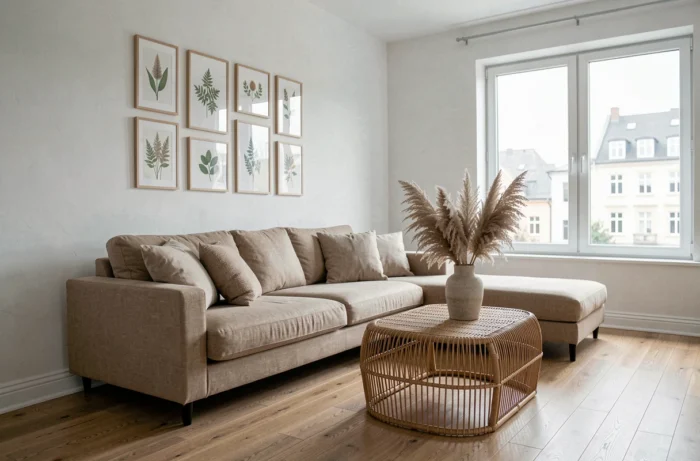
What objective criteria distinguish the 2024 decor trends from one another in terms of sustainability, cost, and health impact? Specialized articles readily list styles (japandi, maximalism, coastal), colors, and materials, but rarely compare these options based on concrete parameters. This article confronts the major decorative directions of 2024 through the prism of materials, their health ratings, and their financial accessibility.
2024 Decor Materials: Comparative Table of Sustainability, Emissions, and Budget
The 2024 decor trends highlight dark wood, chrome, marble, ceramics, and leather. Each of these materials has a distinct profile when considering longevity, level of volatile organic compound emissions, and price range.
| Material | Estimated Lifespan | Common VOC Label | Budget Accessibility |
|---|---|---|---|
| Dark solid wood | Very long (several decades) | A+ (raw, untreated) | Medium to high |
| Chrome / chrome-plated metal | Long (wear-resistant) | Not applicable (inert metal) | Varies by piece |
| Natural marble | Very long | A+ (natural stone) | High |
| Fired ceramics | Very long | A+ (mineral material) | Medium |
| Leather (furniture) | Long if maintained | Variable (glues, dyes) | High |
This table highlights a notable gap: mineral materials and raw wood consistently show the best health performance. Leather, often presented as a hallmark of elegance, heavily depends on its treatments to achieve a good VOC rating.
In France, labeling of volatile organic compound emissions is mandatory for construction and decoration products (paints, varnishes, glues, wall and floor coverings), with a rating from A+ to C since September 1, 2013. However, this health criterion is often absent from most decor guides that recommend materials without specifying their emission levels.
To discover decor at Salon Tendances Habitat, these distinctions between materials allow for informed choices beyond mere aesthetics.
VOC Labeling and Interior Decoration: An Overlooked Angle in Trends
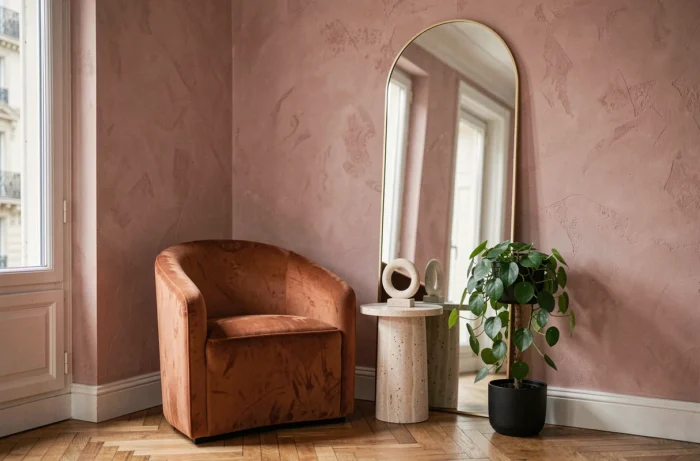
The trendy color palettes of 2024 (terracotta tones, deep greens, bright pinks) imply the application of paints or wall coverings. The chosen hue matters less than the chemical composition of the applied product.
A paint rated C can emit significantly higher levels of formaldehyde than a product rated A+. The difference is invisible to the eye but measurable in the indoor air quality of a living room or bedroom.
The 2024 color trends favor saturated shades (Klein blue, orange, red) that often require more concentrated pigments. In contrast, soft shades and neutral tones (beige, off-white, light gray) generally use simpler formulations with fewer additives.
- Before purchasing paint or varnish, check the VOC emission class on the packaging (mandatory pictogram A+ to C)
- For vinyl or laminate flooring, prefer references labeled A+ that guarantee a minimal level of formaldehyde and toluene emissions
- The glues used for fixing wallpaper or wall coverings are subject to the same labeling: a glue rated B or C can degrade the air quality of a freshly decorated room for several weeks
This technical criterion transforms the decorative choice into a health decision, particularly in children’s rooms or poorly ventilated spaces.
Second-Hand Furniture: The Alternative to New in 2024 Decor
The French second-hand decor market now extends to furniture, lighting, tableware, and decorative objects. According to a report by Ouest-France published on October 2, 2026, shops like L’Hôte idéal in Nantes illustrate this progression of reuse in table art and decoration.
Second-hand allows for creating a unique interior on a limited budget, while fitting into a circular economy logic. This approach complements the aesthetic trends of 2024 with an economic angle that traditional decor guides do not address.
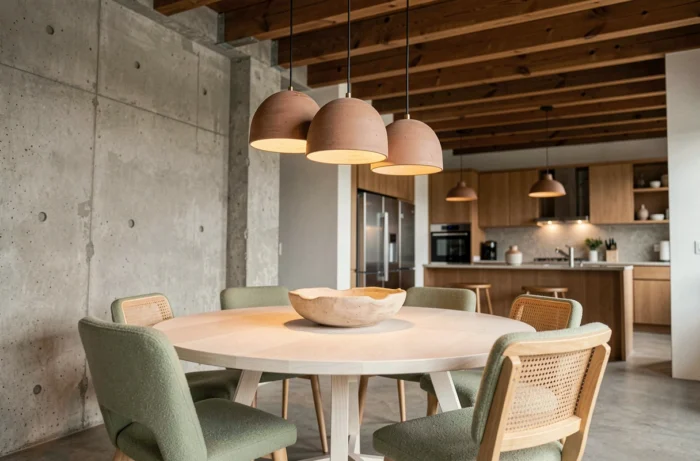
The maximalist style, very present in the 2024 trends, is particularly well-suited for second-hand purchases. Accumulating vintage furniture pieces, mixing eras and patterns costs significantly less at flea markets than in contemporary design stores. In contrast, the minimalist style (japandi, wabi-sabi) requires more specific pieces, the availability of which in second-hand remains uncertain.
Reuse and Real Durability of Materials
A solid wood piece from the 1960s remains functional where a recent particle board piece degrades after a few years. The real durability of a material deserves to be distinguished from its natural appearance. A wood-effect coating on a chipboard substrate does not offer the same longevity or environmental balance as solid oak or walnut.
Solid wood, fired ceramics, and metal withstand decades. Melamine panels, marble-effect plastics, and synthetic textiles lose their appearance within a few years and end up as non-recyclable waste.
2024 Trend Colors and Visual Comfort: What the Data Shows
The palettes identified by competitors fall into three distinct families:
- Energetic colors (bright pink, Klein blue, orange, red) that produce a stimulating effect suitable for living and convivial spaces like the living room
- Earthy tones (terracotta, ochre, brown, olive green) that create a warm atmosphere and pair well with natural materials (wood, linen, ceramics)
- Soft and neutral tones (beige, off-white, pearl gray) that maximize brightness and are suitable for small spaces or north-facing rooms
The choice of a palette depends as much on light exposure as on personal taste. A beautiful terracotta shade in a naturally lit living room will appear dull and lifeless in a dark room. Bright colors consume more ambient light and require stronger supplementary lighting.
Retro patterns and geometric prints, very present in the 2024 trends, work better on limited surfaces (a wall section, cushions, a rug) than throughout an entire room. The accumulation of patterns on walls, floors, and textiles simultaneously creates a visual saturation that tires the eye on a daily basis.
The transformation of an interior in 2024 relies less on adopting a unique style than on the ability to intersect criteria rarely presented together: health performance of materials, real durability beyond appearance, budget accessibility through reuse, and color adaptation to the actual configuration of each space.