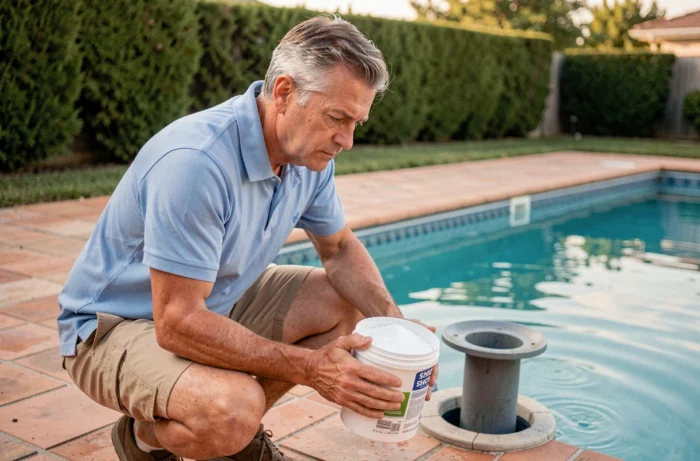
Shock chlorine and the skimmer are two familiar elements for any pool owner. Their association seems logical: the skimmer sucks in water, so placing the product there would ensure rapid diffusion. This idea is based on a confusion between two distinct functions of the hydraulic circuit, and its consequences go beyond the simple mechanical risk to the pump.
Order of shock chlorine treatment: what the hydraulic circuit actually endures
The skimmer is not a chemical product distributor. Its role is limited to skimming the surface of the water and directing debris towards the pre-filter, then the pump and the filter. When a highly concentrated product is introduced, it passes through these components before reaching the pool.
Shock chlorine, whether in the form of granules or fast-dissolving tablets, generates a very high local concentration. This over-chlorinated water passes through the pump, the filter, and the pipes before diluting in the total volume of the pool. The chemical imbalance is therefore maximal where the components are most vulnerable.
The error is not just a corrosion problem on the pump. It is also a poor treatment order: the product acts on the circuit before acting on the pool water. Shock chlorine is designed to quickly destroy chloramines, bacteria, and algae present in the water volume. By routing it first through the technical circuit, part of its oxidizing power is wasted on metal and plastic surfaces.
Before putting shock chlorine in the skimmer, it is essential to understand that this practice reverses the very logic of treatment.
Local concentration and damage to pool equipment: comparison of exposure zones
To measure the extent of the problem, it is necessary to compare what happens in the skimmer with what occurs during direct dissolution in the pool.
| Zone | Volume of water in contact | Chlorine concentration | Exposed components |
|---|---|---|---|
| Skimmer + suction pipe | Several liters | Very high (almost pure product) | Basket, seals, PVC pipes, pump pre-filter |
| Pump and filter | Volume of pump body + filter tank | High (partial dilution) | Mechanical seal, turbine, strainers, filter media |
| Pool (direct dissolution) | Total volume of the pool | Low from the first minutes | Coating (liner, tiles) over a large area |
The difference is clear. In the skimmer, the product remains concentrated in a volume of a few liters throughout the suction phase. The rubber seals and the mechanical seal of the pump are the first affected. In contrast, when shock chlorine is dissolved directly in the pool with filtration running, the dilution is almost immediate over several cubic meters.
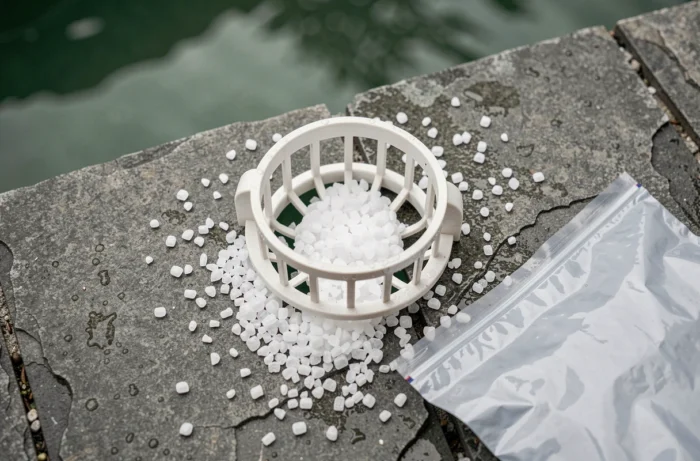
Skimmer baskets, glued fittings, and connecting hoses also suffer from this chemical aggression. Recent technical guides remind us of the need to rinse and disinfect baskets, pipes, and accessories that have been exposed to shock treatment, confirming that the impact goes far beyond just the pump.
Conditions suitable for effective pool shock treatment
Unstabilized shock chlorine degrades quickly under ultraviolet light. Application should be done in the evening or after sunset to allow the product several hours of action in the dark. This precaution, often overlooked, radically changes the effectiveness of the treatment.
Another determining factor: the pH of the water at the time of shock. A pH around 7.0 to 7.2 optimizes the proportion of active chlorine (hypochlorous acid) compared to inactive chlorine (hypochlorite ion). Treating at a pH of 7.8 significantly reduces the disinfecting power of the product, even at the correct dose. Correcting the pH before shock treatment is therefore a preliminary step, not a secondary adjustment.
Sequence of shock chlorine and algaecide: an order to respect
When a shock treatment accompanies an algaecide treatment (after a green water episode, for example), the temptation is to add both products simultaneously. This approach neutralizes the algaecide. Chlorine, a powerful oxidant, degrades the algaecide molecule before it can act on the walls and bottom of the pool.
The sequence recommended by recent technical guides:
- Perform the shock treatment in the evening, with continuous filtration
- Wait for the chlorine level to drop back to a normal level (checkable with a test strip or tester)
- Add the algaecide only after this drop, so that it retains its residual effectiveness
This sequential logic reinforces the argument against passing through the skimmer. An effective shock treatment relies on an orderly protocol where each step conditions the next.
Dissolving shock chlorine directly in the pool: method and precautions
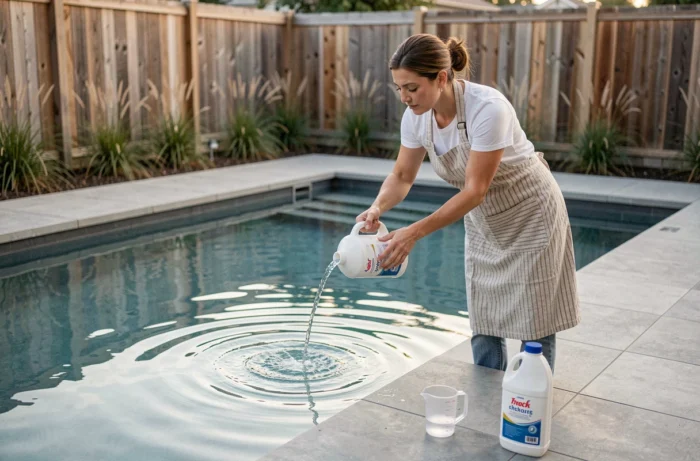
The safest method is to pre-dissolve shock chlorine granules in a bucket of warm water before pouring the solution along the walls of the pool, with filtration running. This technique ensures:
- A homogeneous dilution without concentrated contact with the equipment
- The absence of undissolved granules settling on the liner (risk of localized discoloration)
- A rapid and uniform rise in chlorine throughout the water volume
Pouring granules directly into the pool without pre-dissolution remains possible with certain products, but the risk of stains on the coating significantly increases. Reading the manufacturer’s instructions allows for a decision based on the exact formulation of the product.
For owners who used the skimmer out of habit, a floating dispenser may seem like an alternative. This device is suitable for slow-dissolving stabilized chlorine tablets, whose gradual dissolution does not generate a concentration spike. It is not suitable for shock chlorine, which is precisely designed for a sharp and temporary increase in free chlorine levels.
The shock treatment of a pool relies on three verifiable parameters: a corrected pH before the intervention, an evening application, and a dissolution in the pool volume. Each of these conditions is compromised when the product passes through the skimmer. The protection of equipment and the disinfecting effectiveness depend on the same choice of method.