
The share of accommodation searches for a single night has significantly increased between 2023 and the end of 2025, rising from about a quarter to more than a third of the total search volume. This data, from an Amadeus synthesis published in August 2026, changes the perspective for choosing where to sleep while traveling: the flexibility of booking conditions now weighs as much as the displayed price.
Cancellation policy and booking window: the criteria that comparison sites overlook
We observe that the majority of travel guides compare accommodations by type (hotel, hostel, Airbnb) without ever analyzing the contractual conditions. This is a methodological error. An attractive rate with a non-refundable clause at D-14 becomes a trap as soon as the itinerary changes.
Searches made less than 28 days before the arrival date have significantly increased during the same period. For a long-term traveler, this means that the ability to book late without extra cost determines the actual budget. We recommend systematically filtering by free cancellation policy before sorting by price.
On Booking as well as on Agoda, the same establishment can simultaneously offer a non-refundable rate and a flexible rate with a difference of ten to twenty percent. Booking the flexible version for uncertain stages and the non-refundable version only for locked nights (flight layover, visa with required address) allows for optimization without rigidifying the journey.
Travelers looking for accommodation on Seek and Travel will find useful filters to compare these options by destination.
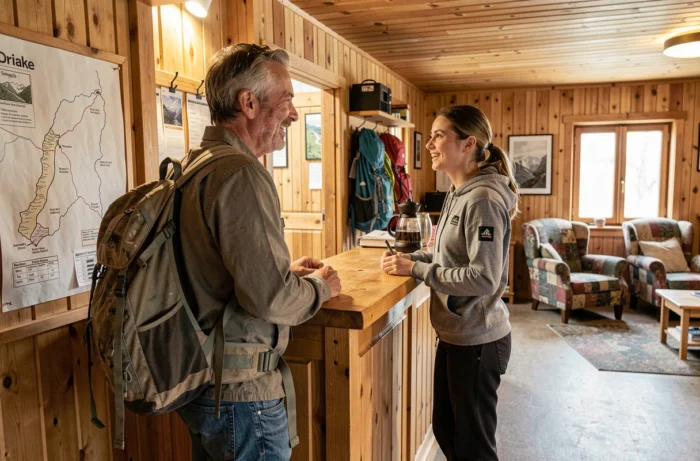
OTAs, metasearch engines, and direct booking: where to search based on the destination
The SiteMinder 2026 report (12,000 travelers, 14 countries) reveals that travelers now start their accommodation search more on OTAs than on Google. This shift has concrete consequences for booking strategy.
In Southeast Asia, regional OTAs (Traveloka, Agoda) list establishments not found on Booking, with locally negotiated rates. In Latin America, independent guesthouses often only appear on Google Maps or via WhatsApp. In Europe, direct booking on the hotel’s website frequently offers a better rate since the European directive on short-term rentals imposes more transparency on fees.
Decision grid by geographical area
- Southeast Asia: prioritize Agoda and Traveloka for catalog depth, then check the direct rate on WhatsApp or the establishment’s website
- Western Europe: compare the OTA rate with direct booking, as independent hotels often align a lower price without intermediaries
- Latin America: combine Booking for major cities and Google Maps for rural accommodations not indexed on platforms
- Southern and Eastern Africa: lodges and camps primarily operate via email or through local agents, with OTAs covering only a fraction of the offer
The reflex to search everything on a single platform guarantees missing out on a significant portion of the local offer.
European regulation on short-term rentals: what changes for travelers
The new European regulatory framework on short-term rentals (like Airbnb, Booking) requires platforms to display a registration number for each listing. This system, currently being deployed in member states, aims to eliminate illegal rentals and ensure reliable offerings.
For travelers, the direct consequence is a gradual cleansing of the available stock. Ghost listings (misleading photos, non-existent accommodations) will become rarer. In return, we anticipate a reduction in the volume of offers in cities where regulation has previously been weak, with a mechanical effect on prices in tight areas.
Checking for the presence of the registration number before booking a short-term rental in Europe becomes a basic reflex. Its absence signals either a host in violation or a risk of last-minute cancellation by the platform.

Balancing comfort, budget, and security: the step-by-step itinerary method
Applying the same level of demand to every night of a long trip is a budgeting mistake. The choice of accommodation is calibrated step by step, not globally.
On a transit stage (overnight layover, bus change at dawn), a dormitory in a hostel or a capsule hotel perfectly fulfills the function. On a rest stage after a trek or a heavy time zone shift, investing in a private room with air conditioning and sound insulation is not a luxury; it’s managing fatigue.
Criteria to weigh according to the type of stage
- Transit stage: proximity to the terminal, luggage storage, late check-in
- Urban exploration stage: central location, access to transport, stable wifi for planning
- Recovery stage: quality of bedding, quietness, breakfast included to limit logistics
- Isolated area stage: reliability of booking (confirmation by email or phone), access to running water, network coverage
This functional breakdown avoids the classic trap of the average budget per night, which artificially smooths needs and leads either to overpaying for transits or under-investing in critical stages.
Online reviews remain useful as long as they are read methodically. We recommend filtering recent reviews (less than three months), targeting those written by travelers with similar profiles (solo, couple, family), and ignoring overall ratings in favor of comments on specific points: cleanliness, noise, wifi reliability. A detailed three-line review is worth more than a five-star rating without text.
The accommodation market is evolving rapidly, with shorter stays, an increase in last-minute bookings, and stricter regulations in Europe. Adapting one’s search method to each geographical area and each type of stage remains the most concrete lever for traveling better without spending more.