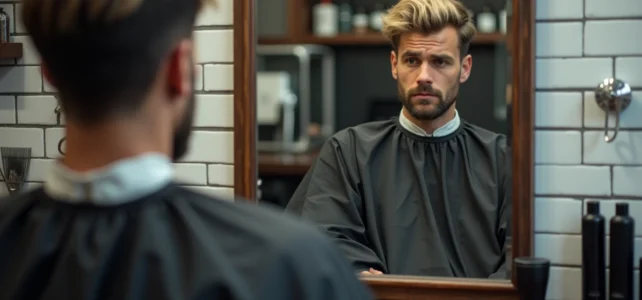
A failed blonde streak in men is quickly noticeable: straw-yellow reflection, too stark a demarcation on a gradient, or a color that contrasts with the natural base. The result depends on the type of mistake made, and the possible corrections vary depending on whether one seeks an immediate solution or a lasting fix. Comparing these options allows for choosing the most suitable method without worsening the damage to hair already weakened by bleaching.
Temporary correction or lasting correction: what difference in results on short hair
| Correction method | Action time | Duration of result | Hair risk | Suitable for short cuts |
|---|---|---|---|---|
| Root touch-up spray (temporary coloring) | Immediate | Until the next shampoo | Almost none | Yes, very suitable |
| Purple or silver shampoo | Several applications | Progressive, to be renewed | Low | Yes |
| Salon glaze or gloss | One session | Several weeks | Moderate | Yes |
| Recoloration tone on tone | One session | Several weeks to a month | Moderate to high | Yes |
| Targeted cut (fade, taper) | Immediate | Permanently (removes the area) | None | Very suitable |
The root touch-up spray, applied about 20 cm from the scalp, allows for temporarily darkening an overly noticeable blonde streak without further bleaching. This option remains the quickest for an event that same evening or a professional appointment the next day.
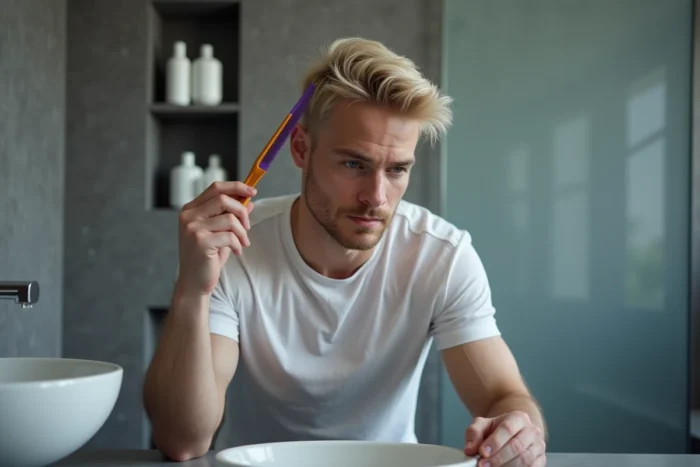
On the other hand, the purple shampoo addresses a different issue: it neutralizes yellow reflections by depositing cool pigments. It does not correct a visible demarcation or an overly wide streak, but it reduces the “straw” effect that betrays a poorly measured bleaching.
For those who want to delve deeper into the topic of quick fixes, it is useful to read the advice from Annuaire Beauté before choosing a method.
Failed blonde streak in men: camouflage by cutting, an underestimated option
Most content on failed streaks directly points to chemical correction. On short men’s hair (taper, undercut, gradient), the cut alone may be enough to eliminate the problem without using any products.
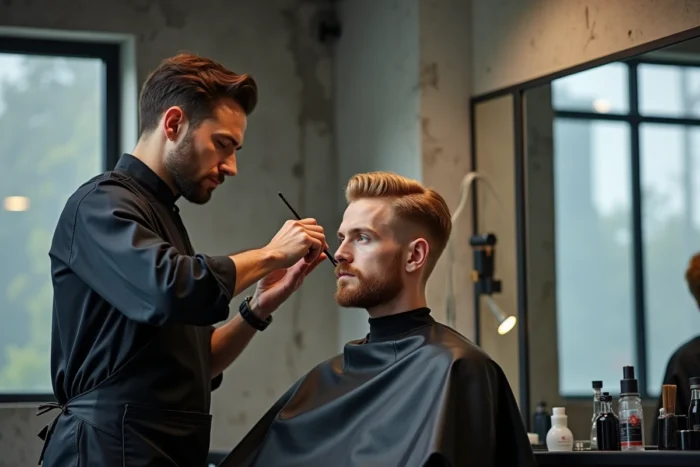
A hairdresser can work on the gradient in the demarcation area, reduce overly light bands by thinning the thickness, or create a fade that integrates the failed streak into the remaining volume. On a low taper, sometimes it is enough to raise the fade line to remove the affected area.
When the cut is not enough
If the blonde streak covers a significant area on the top of the head, the cut does not solve anything without drastically shortening it. In this case, a combination of an adjusted cut and salon glaze provides a more natural result than a complete recoloration.
A texturizing product (matte wax, styling paste) can also help lay down the lengths over the overly light streak to mask it daily, while waiting for regrowth to do its work.
Yellow reflections after bleaching: purple shampoo vs. professional glaze
The yellow or orange reflection remains the most common mistake on a blonde streak in men. The natural base, often dark, releases warm pigments during bleaching. Two approaches oppose each other.
Purple shampoo at home
Purple (or silver) shampoo deposits purple pigments that neutralize yellow through chromatic complementarity. It works well on light reflections, with some limitations:
- The result is progressive: it takes several uses before seeing a clear change, and the effect disappears as soon as you stop
- On a pronounced orange reflection, purple shampoo alone is not enough, as it targets yellow and not orange
- Too long a processing time can turn hair gray-purple, especially on very porous streaks after bleaching
Salon glaze: more precise correction
The glaze (or gloss) applied by a professional hairdresser allows for adjusting the exact shade in one session. It deposits a veil of semi-permanent color that corrects unwanted reflections and unifies the result. The glaze remains the most reliable correction for blonde that has turned straw-yellow.
Unlike purple shampoo, the glaze also acts on orange reflections. A colorist can mix ashy or pearly tones to achieve the desired blonde, which consumer products cannot do with the same precision.
Repair routine after a failed bleaching: protect before correcting
Correcting the color is pointless if the hair breaks in the meantime. Men’s hair, often washed daily and exposed to heat tools, does not handle a failed bleaching followed by immediate chemical correction well.
Before any new color intervention, a hair resting phase is essential. The steps to adopt:
- Switch to a gentle sulfate-free shampoo to limit the stripping of remaining pigments and preserve hydration
- Space out washes as much as possible, even if the habit is to wash every day
- Apply a protein or repairing mask once or twice a week to strengthen the weakened fiber
- Stop using heat tools (high-temperature hairdryer, straightener) for several weeks
Bond repair treatments, offered by several professional brands, reconstruct the broken disulfide bonds during bleaching. Waiting several weeks before any new chemical treatment reduces the risk of breakage and allows the hairdresser to work on more resilient hair during the final correction.
Common mistakes that worsen the problem
Recoloring oneself with a permanent dye on hair already damaged by a failed bleaching remains the primary cause of irreversible damage. Permanent dye opens the cuticle to deposit pigments, which further weakens an already porous fiber.
Applying a scrubbing shampoo before a home recoloration, without an intermediate repairing mask, combines two chemical aggressions. Any color correction on weakened hair should be done by a professional hairdresser, who can assess porosity and adapt the protocol.
A failed blonde streak in men is corrected all the better when one first identifies the exact nature of the problem (reflection, demarcation, width) before choosing between temporary spray, adjusted cut, or salon intervention. Healthy hair can handle a chemical correction, while already brittle hair cannot. The hair diagnosis conditions everything else.