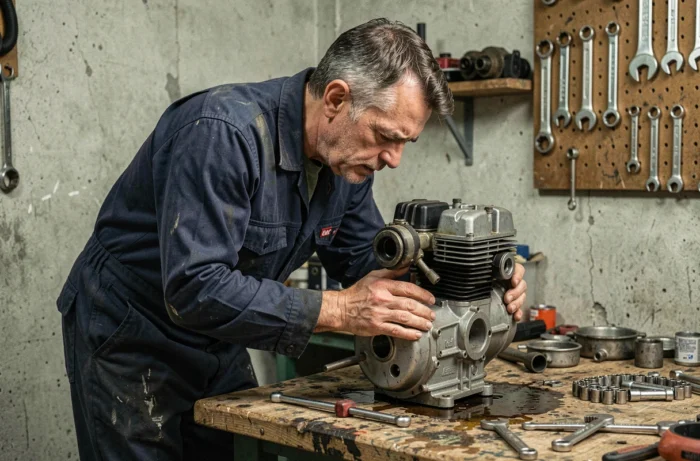
The Honda Dax 125 features a single-cylinder engine from the Honda family, which also powers the Monkey 125. Two bikes, one engine block on paper, yet different sensations in use. Before choosing an engine for the Dax 125, it’s essential to understand what goes beyond the technical specifications: electronic management, pollution standards, transmission, and actual behavior on the road.
Euro 5+ Standard on the Dax 125: What It Means in Practice
Most guides compare the Dax 125 engines based on the advertised power. The problem is that this power is legally capped at 11 kW, or about 15 hp for the A1 category. All homologated 125 engines comply with this limit, regardless of the model year.
What really varies from one version to another is the applied pollution standard. The latest versions of the Dax 125 have moved to the Euro 5+ standard, a step above the classic Euro 5. In practice, the engine incorporates a stricter injection mapping to limit emissions.
Have you ever noticed that the same model seems less lively from one year to the next? This is often related to this evolution. The torque available at low revs may be slightly reduced compared to Euro 4 versions. The mechanics remain reliable, but the throttle response changes subtly.
To clearly understand the differences between the various versions of the Honda block, a comparison of Dax 125 engines allows you to visualize these nuances that are often invisible on a manufacturer’s sheet.

Dax 125 Engine and Motorcycle Technical Inspection: An Overlooked Selection Criterion
Since April 15, 2024, technical inspection has become mandatory in France for all category L vehicles, including 125s. This point changes the way one considers the choice and preparation of a Dax 125 engine.
An unapproved exhaust or a modified line without certification can lead to a refusal at the inspection for excessive noise levels. “Wild” engine modifications (changing the cylinder, reprogramming outside the framework) become a real risk.
What the Technical Inspection Checks on a 125
- The noise level at the exhaust, measured according to regulatory thresholds. An unapproved sports exhaust is enough to block the passage.
- Pollutant emissions, which makes Euro 5 or Euro 5+ engines easier to validate than older or modified blocks.
- The general condition of the exhaust system, the catalyst, and the injection system, with no possibility for last-minute tinkering.
Any sale of a Dax 125 over five years old requires a valid technical inspection certificate to be handed to the buyer. If you are considering a used purchase with a modified engine, ensure that the bike passes the inspection before signing.
Electronic Management and Clutch: Where Dax 125 Engines Stand Out
The single-cylinder engine of the Dax 125 is an electronically injected block, air-cooled. On paper, nothing spectacular. In reality, the injection mapping determines the character of the engine much more than the displacement itself.
Honda uses a PGM-FI (Programmed Fuel Injection) system that adapts the air-fuel mixture in real-time. Depending on the model year and the applied Euro standard, this mapping varies. A Euro 5+ Dax will have a more conservatively calibrated injection than a first-generation Euro 5 model.
Transmission and Clutch: The Real Feel at the Handlebar
The Dax 125 has a four-speed gearbox. The automatic centrifugal clutch simplifies city riding, but it also imposes a specific riding style. There’s no friction point to manage: you shift gears with your foot, and the engine takes care of the rest.
Why does this technical choice matter? Because it makes the Dax accessible to holders of a category B license after a seven-hour training, while limiting mechanical customization options. A manual clutch, like on some alternative engine kits (such as Lifan or YX), offers more control but falls outside the original homologation framework.
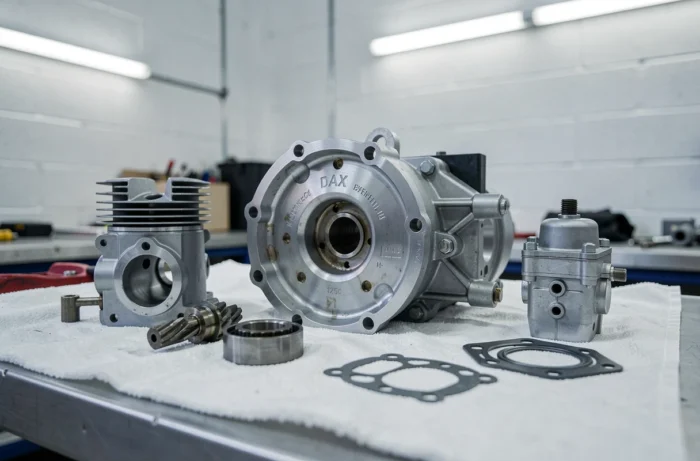
Original Honda Engine or Alternative Block: What Choice for a Dax 125
On specialized forums, the question often arises: should you keep the Honda engine or switch to a Chinese block like Lifan, Zongshen, or YX? The answer depends on the intended use.
- The original Honda engine guarantees road homologation, compatibility with technical inspection, and a structured network of spare parts. This is the only reasonable choice for daily use on open roads.
- Alternative blocks (Lifan, YX) offer actual displacements that are sometimes higher and a manual clutch. They are suitable for Dax projects intended for leisure or track use but pose homologation issues.
- A Lifan or YX engine mounted on a Dax chassis often requires adaptations in terms of mounting, exhaust outlet, and wiring harness. The total cost frequently exceeds that of the Honda block.
The choice boils down to a simple question: ride legally on the road or build a leisure project without homologation constraints.
Dax 125 Engine Maintenance: What Preserves Longevity
The Honda single-cylinder engine of the Dax 125 is known for its robustness, provided you adhere to a few fundamentals. Regular oil changes remain the most crucial maintenance task for this type of air-cooled block.
Air cooling means that the engine runs hotter in slow urban traffic than in smooth riding. Repeated short trips put more strain on the oil. Adjusting the oil change frequency to actual usage, rather than following a fixed schedule, protects the engine over time.
The air filter also deserves special attention. On a small single-cylinder engine, a clogged filter quickly alters the air-fuel mixture and degrades throttle response. A visual check every few thousand kilometers is enough to detect premature clogging.
The Dax 125 engine does not require advanced mechanical expertise for proper maintenance. Its simplicity is part of its appeal, provided one does not confuse simplicity with negligence.