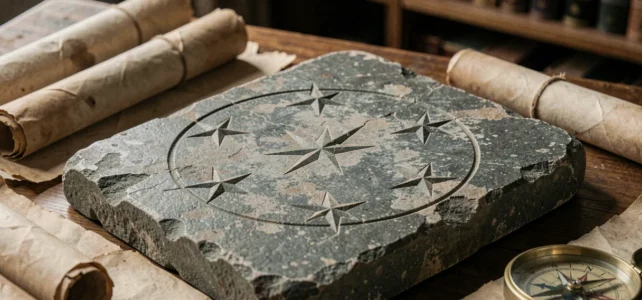
In the book of Revelation, the apostle John describes a vision where Christ holds seven stars in his right hand and walks among seven golden lampstands. This passage (Revelation 1:12-20) forms the main textual foundation of the symbol of the seven stars in the Christian tradition. The text itself identifies these stars as the angels (or messengers) of the seven churches of Asia Minor, and the lampstands as the churches themselves.
This image has traversed the centuries, accumulating layers of meaning far beyond its literal reading. Understanding the spiritual meaning of the 7 stars requires untangling what pertains to the biblical text, theological interpretation, and later esoteric reappropriations.
Seven-branched star and Seal of Solomon: two distinct symbols
A common confusion mixes the seven-branched star (heptagram) and the Seal of Solomon, which traditionally refers to a six-branched star formed by two interwoven triangles. The two figures have neither the same geometry nor the same symbolic history.
The heptagram, with its seven points, appears in several traditions. In sacred geometry, it is associated with the seven days of Creation, the seven planets known in antiquity, and the seven divine attributes in certain branches of Jewish and Christian mysticism. The number seven carries a charge of divine fullness and completeness.
The Seal of Solomon, on the other hand, pertains to a symbolism of the union of opposites (fire and water, masculine and feminine, heaven and earth). Attributing to the pentagram or hexagram the spiritual properties of the heptagram amounts to confusing different systems of thought. The number of branches radically changes the interpretation.

The seven stars in John’s Revelation: text and theological interpretation
The passage from Revelation 1:20 provides its own key to interpretation: “The seven stars are the angels of the seven churches.” The Greek term angelos can refer to a human messenger (a community leader) or a celestial being. This ambiguity has fueled exegetical debates since the early centuries.
Several recent readings emphasize a collective dimension. The seven stars would not simply represent seven individuals, but a collective magisterium held in the hand of Christ. This interpretation makes the stars a symbol of spiritual governance placed under direct divine sovereignty, rather than an attribute of personal power.
The gesture of holding the stars in the right hand also carries a precise meaning. In ancient iconography, the right hand is one of authority and protection. Christ does not contemplate the stars from a distance: he grasps them. Recent sermons and worship guides highlight this practical dimension:
- Christ “holds the seven stars” and “walks among the seven lampstands,” which is interpreted as a continuous and concrete presence within local communities
- Spiritual leaders (messengers) are placed under direct sovereignty, which has implications for how to preach and govern the Church
- The community is invited to see itself as a place where the “bearer of the stars” is truly present, not just evoked metaphorically
This reading goes beyond decorative symbolism. It makes the seven stars an ecclesiological tool, a model of organization where the light of each community depends on its connection to the central source.
Seven stars, seven planets: the bridge between ancient astronomy and spiritual reading
Before the telescope, the visible sky to the naked eye counted seven “wandering stars”: Sun, Moon, Mercury, Venus, Mars, Jupiter, Saturn. These seven celestial bodies structured calendars, the days of the week, and the astrological systems of Babylon, Greece, and Egypt.
The choice of the number seven in Revelation is likely not unrelated to this surrounding cosmology. Recent works explore this convergence by proposing to reconnect biblical exegesis and astronomical observation. The Pleiades, a star cluster visible to the naked eye composed of seven main stars, are sometimes cited in this perspective, notably in reference to the book of Job (Job 38:31) where God asks: “Can you bind the chains of the Pleiades?”
The seven stars then become a bridge between spiritual symbolism (guidance, wisdom, completeness) and an observable reality in the night sky. This dual reading, both astronomical and mystical, transforms the observation of the sky into a support for meditation on creation.

Symbol of the seven stars in esotericism and Freemasonry
Outside the strictly biblical framework, the heptagram and the motif of the seven stars have been taken up by several esoteric currents. In Freemasonry, the stars appear in the decor of certain temples, often associated with the seven liberal arts of the trivium and quadrivium (grammar, rhetoric, logic, arithmetic, geometry, music, astronomy).
In medieval alchemy, each planet was associated with a metal: gold for the Sun, silver for the Moon, mercury for Mercury, copper for Venus, iron for Mars, tin for Jupiter, lead for Saturn. The seven stars represented the stages of inner transmutation, each “planet” representing a stage of purification of the soul.
These reappropriations are not distortions of the biblical text. They testify to the symbol’s ability to migrate between systems of thought. However, they make the reading more complex: the same visual motif carries divergent meanings depending on whether it is read through the lenses of the exegete, the astronomer, or the alchemist.
What the seven stars are not
The main risk of this symbol is overinterpretation. The seven stars of Revelation are not a horoscope, nor a system of chakras, nor a guide to personal development. John’s text anchors them in a precise context: Christian communities of the first century, facing persecution, receiving a message of reassurance.
Projecting foreign interpretative grids onto this symbol is not illegitimate in itself, but it deserves to be noted. Each tradition that seizes the motif deposits its own expectations, and the “original” meaning becomes progressively obscured.
The motif of the seven stars continues to circulate in visual arts, symbolic jewelry, and contemporary meditative practices. Its strength lies precisely in this plasticity: old enough to carry authority, simple enough to accommodate new meanings. The only precaution that must be taken is to always specify from which framework one speaks; otherwise, the symbol loses depth in exchange for popularity.