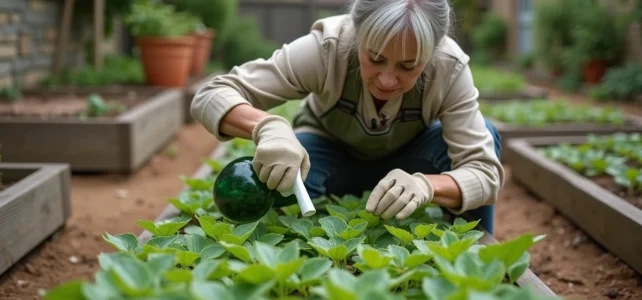
Purslane (Portulaca oleracea) colonizes warm, dry soils with formidable efficiency. Its ability to reproduce through stem fragments and seeds makes any late intervention almost useless. Here, we discuss truly effective weeding methods, taking into account the French regulatory framework that severely limits chemical options.
Labbé Law and authorized herbicides against purslane: what you can buy
Since January 1, 2019, the Labbé law prohibits individuals from purchasing, possessing, and using any synthesized herbicide. This includes glyphosate-based products and all conventional selective herbicides. An amateur gardener wishing to use a herbicide for purslane must turn to two categories of legal products.
The first: biocontrol products, based on pelargonic acid or concentrated acetic acid. These substances work by contact, destroying the leaf cuticle. They do not migrate to the roots.
The second: products labeled EAJ (authorized for use in gardens). This label ensures that the product has been evaluated for domestic use. In garden centers, always check for this symbol on the packaging, as some “natural” products lack it and are not legally usable by individuals.
Purslane, as a succulent plant, stores water in its stems and leaves. This water reserve dilutes the effect of contact herbicides and protects internal cells. This is why a single application of pelargonic acid burns the surface foliage without killing the plant.
Pelargonic acid on purslane: effective application protocol
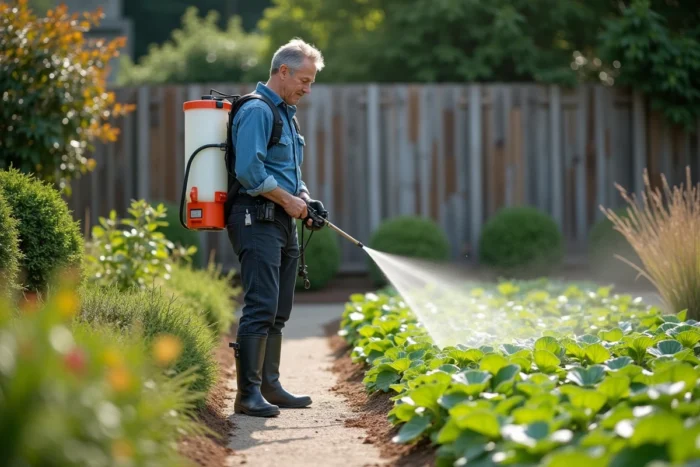
Pelargonic acid remains the most common biocontrol active ingredient against weeds in the garden. On purslane, its effectiveness entirely depends on the application protocol.
Timing and weather conditions
We recommend applying the product in early morning during dry, sunny weather. The heat accelerates the desiccation of affected tissues. Rain within two hours after application cancels the treatment’s effect. The wind should be light to avoid drift onto neighboring crops.
Growth stage of purslane
Purslane is vulnerable only in its young stage, when the seedlings have four to six leaves and the stems have not yet developed their characteristic fleshy thickness. Treating an adult purslane with a contact herbicide is a waste of product. The plant regrows from the base within a few days.
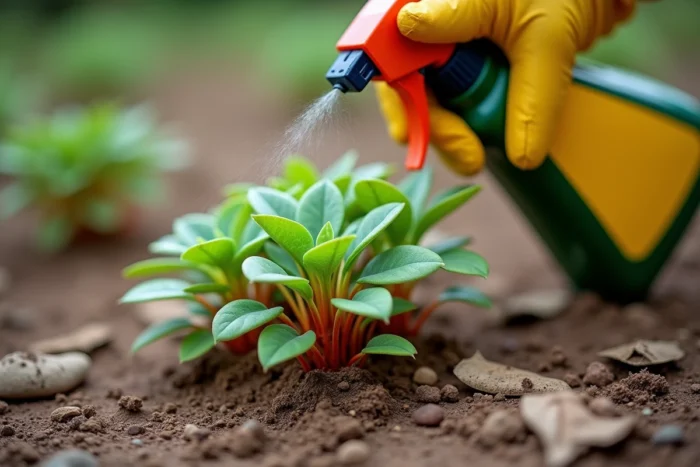
On an already established purslane, the only viable strategy with pelargonic acid is to manually cut the stems at ground level, then spray as soon as the regrowth emerges, at the cotyledon stage. This double intervention breaks the cycle of reserve reconstitution.
Frequency of applications
A single application is never enough. Purslane germinates in successive waves throughout the summer. Plan for at least three applications spaced ten to fifteen days apart during the June-August period to maintain pressure.
White vinegar and salt: real effectiveness on Portulaca oleracea
White vinegar (acetic acid at 8-14%) is among the most widely shared natural herbicide recipes. On purslane, we observe partial effectiveness comparable to that of pelargonic acid, with the same limitations: contact action, no translocation to the roots.
Adding salt (sodium chloride) to the mixture increases the short-term desiccating effect. However, salt sterilizes the soil and accumulates there permanently. In a vegetable garden or flower bed, this practice compromises subsequent crops. We strongly advise against it on any surface intended for planting.
- Pure white vinegar: rapid leaf burn, frequent regrowth within ten days, no soil damage
- Vinegar mixed with salt: more pronounced effect on foliage, but progressive salinization of the soil
- Boiling water: destroys tissues through thermal shock, effective on young seedlings, no chemical residues, but heavy logistics on large areas
Regardless of the chosen “homemade” product, the result on mature purslane remains disappointing without prior uprooting of the most developed plants.
Mechanical weeding and mulching: the combination that limits the return of purslane
Chemical weeding, even with authorized products, does not solve the underlying problem: the seed bank present in the soil. A single purslane plant can produce several tens of thousands of viable seeds, capable of persisting in the soil for years.
Manual uprooting remains the most effective method provided two strict rules are followed:
- Remove the entire plant, including easily broken stem fragments. Every piece left on the ground can root
- Intervene before flowering, when the stems are still soft and seed capsules have not yet formed
- Never leave uprooted plants on the garden soil. Compost them only in a hot compost that reaches a sufficient temperature to destroy the seeds
Thick mulching is the essential complement to any weeding against purslane. Purslane needs direct light and bare soil to germinate. A layer of organic mulch (straw, wood chips, dead leaves) maintained permanently deprives the seeds of the necessary conditions for their emergence.
However, be careful: too thin or poorly maintained mulch allows enough light to permit germination. Aim for a generous thickness and renew the mulch as soon as it decomposes.
Purslane exploits every inch of bare soil. The combination of early uprooting, biocontrol treatment on regrowth, and permanent mulching yields the most lasting results. None of these three actions, taken in isolation, can eradicate an established infestation.