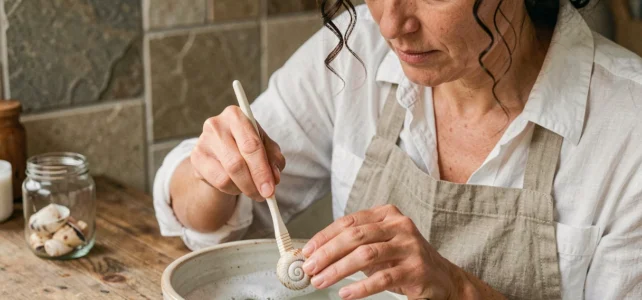
The eye of Saint Lucia is a calcareous operculum secreted by the mollusk Bolma rugosa, found in the Mediterranean. Its characteristic spiral makes it a prized piece for jewelry creation. Two questions arise before setting this operculum: how to clean it without damaging its soft surface, and what setting to choose so that it withstands salt, sweat, and sunscreen worn by the seaside.
Resistance of the eye of Saint Lucia according to the type of setting
The choice of support and fixation directly determines the longevity of the jewelry. Not all settings react the same way to marine aggressions.
| Type of setting | Resistance to salt and sweat | Risk of detachment | Maintenance required |
|---|---|---|---|
| Epoxy glue on metal bail | Medium (epoxy degrades with repeated saltwater exposure) | High after several months of exposure | Rinse with fresh water after each swim |
| Stainless steel claw setting | High (no glue, mechanical hold) | Very low | Periodic check of the claws |
| Wire wrapping | Variable depending on the metal (brass tarnishes, steel resists) | Low if the wire is tightly secured | Drying after contact with water |
| Drilling and through ring | High (fixation within the mass) | Almost none | Minimal |
Mechanical setting and drilling offer the best hold against coastal conditions. Gluing, often used by beginners, remains the weak link when the jewelry is worn daily near water.
Before choosing your method, it is useful to understand how to make a piece of jewelry with an eye of Saint Lucia starting from the initial cleaning of the operculum to the finishing touches.

Cleaning an eye of Saint Lucia without damaging its calcareous surface
The operculum of Bolma rugosa is made of calcium carbonate, a relatively soft material. This calcareous nature requires avoiding several common techniques in jewelry making.
What to avoid
- Ultrasonic cleaners and steam, which weaken the porous structure of the operculum and can cause micro-cracks
- White vinegar, lemon, and any acid, even diluted, which attack the limestone and make the surface dull in a few minutes
- Hard brushes (brass, steel) that scratch the pearly layer and remove the characteristic spiral
- Aggressive chemical products (ammonia, bleach) that discolor the colored face of the operculum
Suitable cleaning protocol
After collection, soak the opercula in warm fresh water for one to two hours. This bath loosens sand and organic residues without attacking the material.
Then, gently scrub each piece with a soft toothbrush and a bit of Marseille soap. Neutral soap preserves the limestone where a regular detergent would leave a dull film.
Rinse thoroughly with clear water, then dry with a soft cloth. For heavily soiled opercula (embedded algae, mineral deposits), prolonged soaking for several hours in warm water usually suffices to soften the residues before brushing.
Polishing the eye of Saint Lucia: grains and limits
Polishing transforms a raw operculum into a jewelry piece. The difficulty lies in the fact that over-polishing destroys the spiral, which is precisely the visual appeal of the eye.
Start with medium-grit sandpaper to smooth out the irregularities of the flat face (the one that will be glued or set). Then move to fine grit on the spiral face, making light circular motions. The goal is to achieve a satin finish, not a mirror polish.
A polishing felt with a soft paste (like polishing paste for shells or soft stones) gives the final finish. Each sanding step removes material irreversibly, which requires regularly checking the condition of the spiral between passes.
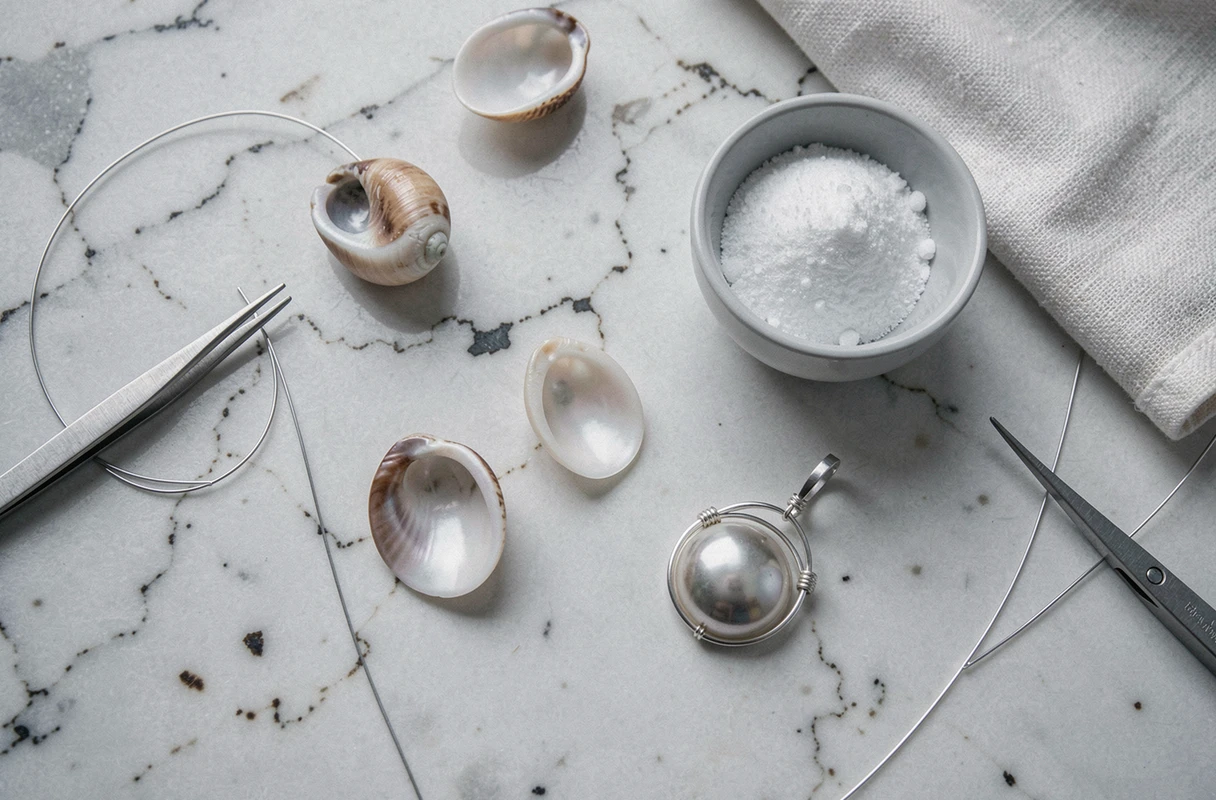
Durable eye of Saint Lucia jewelry by the sea: technical points
The question of durability in a marine environment goes beyond the setting. The metal of the support and wearing habits are equally important.
Choice of metal
Stainless steel resists salt without tarnishing, making it the best ally for jewelry worn at the beach. 925 silver, more common in handmade jewelry, tarnishes with repeated exposure to sweat and salty air. It then requires regular cleaning. Brass and gold-plated materials degrade even faster.
Habits that prolong durability
Recent guides emphasize a often overlooked point: remove the jewelry before applying sunscreen or perfume. These cosmetic products contain solvents and fatty substances that infiltrate the glue or under the setting, accelerating the yellowing of the operculum.
After swimming in the sea, a simple rinse with fresh water followed by air drying is enough to eliminate salt crystals. If the jewelry is worn daily in summer, this rinsing should become a reflex, just like rinsing a diving mask.
Protective varnish
Applying a thin layer of clear marine varnish on the spiral face creates a barrier against moisture and UV rays. This protection is not permanent (it wears off in a few months), but renewing the varnish once or twice per season preserves the shine of the spiral much better than any treatment. Use a varnish without aggressive solvents to avoid attacking the underlying limestone.
Off-season storage also matters. A soft fabric pouch, away from direct light, prevents the natural yellowing of the limestone and protects the surface from accidental scratches.
An eye of Saint Lucia set on stainless steel, mechanically set, and rinsed after each exposure to salt remains the setting that requires the least maintenance for the best longevity. Gluing remains an accessible option, provided one accepts more regular follow-up and a likely replacement of the glue after a few seasons.