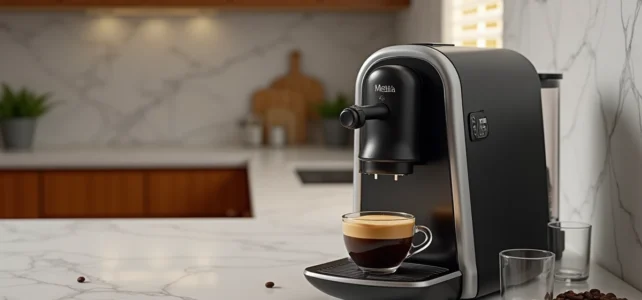
When you take the Melitta Caffeo Solo E950-222 out of its box, you tend to want to brew a coffee right away. The problem is that the initial settings determine the quality of each cup for months. This compact coffee machine hides some subtleties that most guides overlook, particularly regarding the choice of allowed beans and diagnosing irregular coffee.
Banned beans and suitable water: what the Caffeo Solo refuses
Before even discussing settings, we must filter what we put into the machine. The Melitta Caffeo Solo E950-222 is designed exclusively for roasted coffee beans without additives. Caramelized, iced, or sugar-coated coffees are explicitly discouraged by the manufacturer.
The reason is mechanical: these sticky residues clog the grinder and the extraction chamber. In the medium term, you end up with a jammed grinder and repeated maintenance alerts. If you buy flavored coffee beans, check the label: the mention “natural flavors added” generally poses no problem, but any visible coating on the bean should be avoided.
As for water, only tap water or still filtered water is suitable. Sparkling water, even lightly carbonated, damages the internal circuit. You can find all these guidelines in the Melitta Caffeo Solo E950-222 manual, which also details the initial rinsing procedure.
Grinder adjustment and volume of the Melitta Caffeo Solo: two distinct levers

A point that competing content often treats confusingly: on the Caffeo Solo, grind fineness and cup volume are two separate parameters. Mixing the two in your mind guarantees you will go in circles without finding the right result.
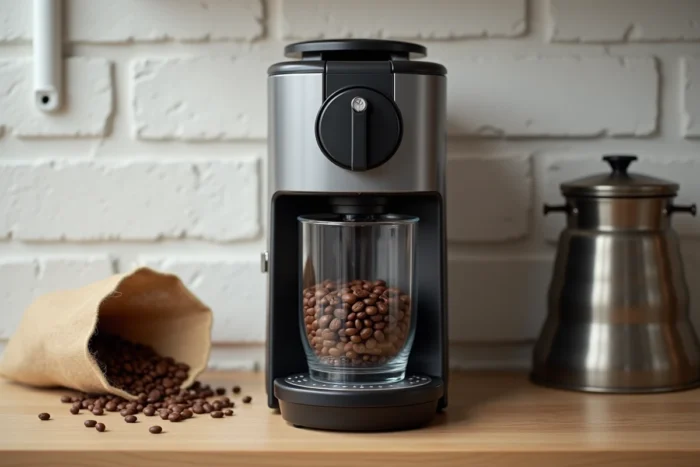
The grinder is adjusted with the knob located inside the bean compartment. You only turn it when the grinder is in operation (during coffee preparation). Turning it while empty risks jamming the burrs.
- Finer grind (towards the lower numbers): slower extraction, stronger coffee, and shorter in mouthfeel, with more body
- Coarser grind (towards the higher numbers): faster extraction, longer and milder coffee, sometimes watery if overdone
- Cup volume: adjusted separately via the dedicated button on the panel, it determines the amount of water that passes through the grind without changing the fineness of the bean
In practice, you first set the grind to a middle position, then adjust the volume. Each grind adjustment requires two to three coffees before stabilizing the taste, because ground coffee from the previous setting remains in the circuit.
Coffee too short, too strong, or irregular despite intensity settings
This is the most frustrating situation: you’ve adjusted everything, and the result remains inconsistent. An irregular coffee on the Caffeo Solo rarely points to a bad setting, but rather to clogging or a startup issue.
Check the extraction chamber
The extraction chamber (or coffee group) of the Caffeo Solo is removable. This is an advantage over some competing machines, but it must be used. If the coffee flows too short or irregularly, the first thing to do is remove this part and rinse it with clear water, without soap.
Compact coffee residues in the chamber alter the extraction pressure. The coffee passes through more difficultly, resulting in an overly concentrated espresso or a choppy flow. Weekly cleaning of this part resolves most irregularity issues.
Identify a descaling problem
When limescale accumulates in the circuit, the water flow gradually decreases. You then get increasingly short coffee without having changed any settings. The machine has a built-in descaling program that activates via a warning light, but do not wait for the alert if the water in your area is very hard.
Feedback varies on this point: some users in soft water areas only descale two to three times a year, while in hard water areas, a monthly cycle may be necessary. The Pro Aqua filter, compatible with the Caffeo Solo, reduces the frequency of descaling by filtering some of the limescale upstream.
Rule out a bean problem
Overly strong coffee despite a coarse grind and high volume may simply come from overly roasted beans. Very dark “espresso” roasts, popular in supermarkets, produce bitter and strong coffee even with mild settings. Testing a medium roast bean allows you to quickly confirm or rule out this possibility.
First startup and type number: two details that tutorials often overlook
The initial setup procedure conditions the proper functioning later on. During the very first power-up, the machine requests a complete rinsing cycle. Skipping this step causes unnecessary alerts and can skew the first coffees.
Another often overlooked point: to download the correct manual or contact Melitta customer service, you need to identify the type number written under the device. “Caffeo Solo” covers several variants (E950-101, E950-222, E950-333), and the descaling or reset procedures may slightly differ from one version to another. Relying on a generic “Solo” manual found online exposes you to inappropriate instructions.
The Caffeo Solo E950-222 remains a compact coffee machine designed for espresso and black coffee, without an integrated milk system. Accepting this limitation also means understanding that all engineering is focused on the quality of bean extraction. A clean grinder, suitable water, and the correct grind setting are enough to produce a consistent result, cup after cup.