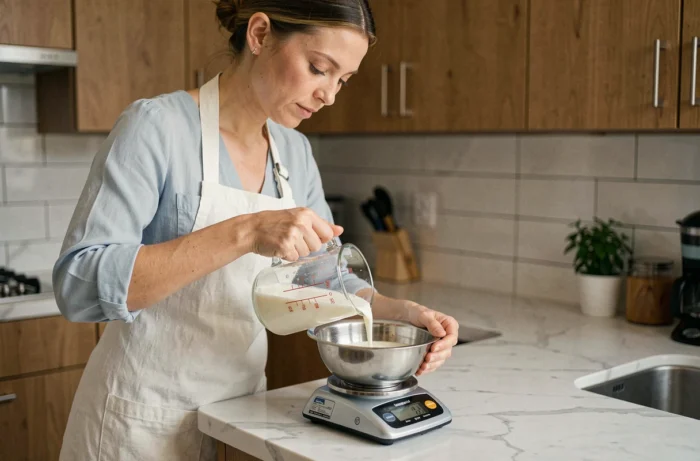
To get measurements right in cooking or pharmacy, it’s not enough to read a volume on a measuring cup and convert it directly into grams. Converting millilitres to grams relies on a specific physical property—density—which varies from one ingredient to another. The same volume of honey, flour or water does not weigh the same. Understanding how this works helps you avoid significant discrepancies in your preparations.
American recipes in cups and ounces: conversion pitfalls when converting to grams
Recipes from the United States present a problem that standard conversion charts rarely mention. They mix two measurement systems whose units sometimes share the same name without referring to the same thing.
US nutrition labelling regulations define a cup as 240 ml, while the customary US measure is about 237 ml. A 3 ml difference may seem insignificant for a single cup, but it adds up when a recipe calls for several.
Another common source of confusion is the ounce. A fluid ounce measures volume, while a standard ounce measures weight: the two are not interchangeable. Applying a conversion factor intended for volume to a weight measurement throws off the quantity from the outset. So before converting anything, first identify whether the recipe gives a volume or a weight.
To convert millilitres to grams from a foreign recipe, first convert cups to millilitres using the relevant standard, then apply the density of the ingredient in question. Skipping either step introduces an error in every line of the recipe.
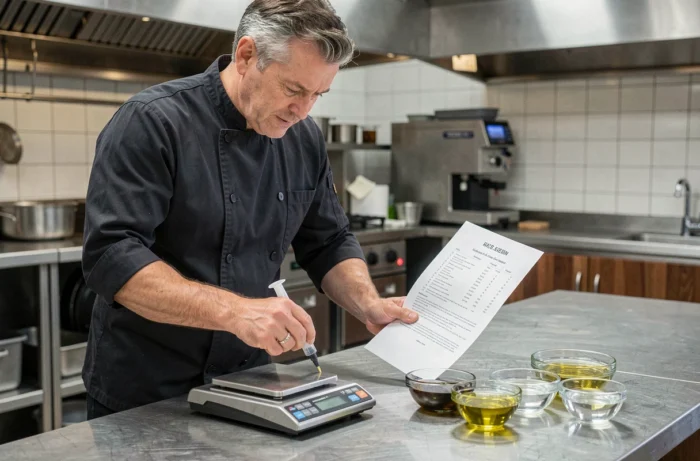
Density of common ingredients: a comparison table of differences
The basic formula is simple: mass in grams = volume in millilitres x density. The challenge lies in choosing the right density value. The table below lists the ingredients most commonly used in cooking and everyday measuring.
| Ingredient | Approximate density (g/ml) | Mass per 100 ml |
|---|---|---|
| Water (at 4 °C) | 1.00 | 100 g |
| Whole milk | 1.03 | 103 g |
| Honey | 1.42 | 142 g |
| Vegetable oil | 0.90 | 90 g |
| Wheat flour | 0.59 | 59 g |
| Granulated sugar | 0.85 | 85 g |
The difference between honey and flour is striking: for the same volume of 100 ml, honey weighs almost two and a half times as much as flour. Using the rule “1 ml = 1 g” for these two ingredients results in a major error.
Water is the only case where the 1:1 conversion is almost exact, provided its temperature is close to 4 °C. In practice, tap water at room temperature has a density close enough to 1.00 that the difference is negligible for cooking.
Why a generic density chart isn’t always enough
The values in the table above are averages. Several practical factors can change them enough to make a generic conversion unreliable when precise measurements matter.
Compacting and sifting powders
Flour illustrates the problem well. Sifted flour takes up more volume than flour compacted at the bottom of a bag. Compacting, sifting or moisture changes the mass of the same volume of powder. A measuring cup filled by tapping the container will not weigh the same as one filled with loosely spooned flour.
Rounding on labels
US regulations require metric equivalents for household serving sizes on nutrition labels to be rounded. A value read from a package is therefore not necessarily precise enough to reproduce a measurement to the nearest gram. This difference is acceptable for everyday use, but can be a problem in baking or pharmaceutical preparations.
Temperature and the state of the liquid
A liquid’s density changes with temperature. Hot oil is slightly less dense than cold oil. For most recipes, the difference is marginal. However, with heated sugar syrup or melted butter, it can amount to several grams in a 250 ml volume.
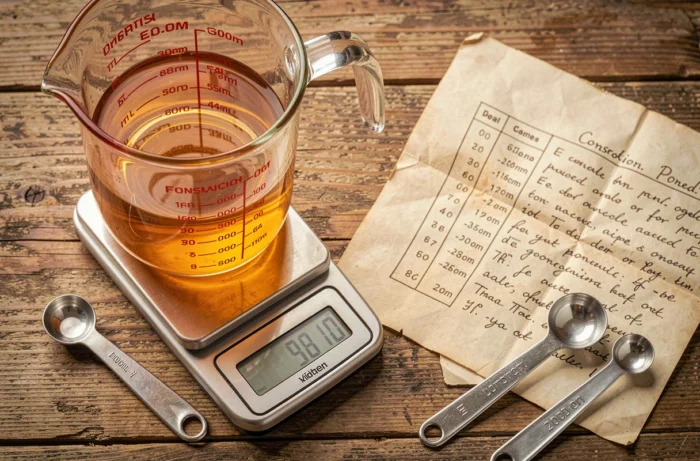
When to skip conversion and weigh ingredients directly
This question comes up whenever the accuracy of a measurement determines the final result. Three situations call for putting down the measuring cup and taking out the scales.
- Fine powders (flour, cocoa, starch), whose density varies considerably depending on how compacted they are: weighing removes this variable and gives a consistent result every time.
- Homemade pharmaceutical or cosmetic preparations, where a difference of a few grams can affect the finished product’s effectiveness or tolerability.
- Technical baking recipes (macarons, choux pastry, meringue), where the precise ratio of dry ingredients to liquids determines the final texture.
Weighing is the only method that eliminates variables associated with volume (compacting, the meniscus, temperature). Online converters and charts are useful for quick estimates, but they cannot account for actual measuring conditions.
Measuring techniques: what converters can’t account for
Even with the right density, the accuracy of the result depends on how the volume is measured. Two simple techniques help reduce the most common discrepancies.
- For liquids: place the container on a flat surface and read the level at eye height, at the bottom of the meniscus (the curve formed by the liquid against the side of the container). Looking down at it consistently adds a few phantom millilitres.
- For dry ingredients measured by volume: fill the measure without compacting the ingredient, then level it with the back of a knife. This technique standardises the actual volume and limits differences caused by pressure on the powder.
- For semi-solid fats (soft butter, hazelnut paste): ml-to-gram conversions are unreliable because trapped air distorts the volume. Direct weighing is the only sensible option.
Converting millilitres to grams works well for homogeneous liquids with a known density. As soon as the ingredient is a powder, a paste or a product whose state changes with temperature, a density chart provides an estimate, not a certainty. Even a basic kitchen scale remains the tool that closes the gap between the volume measured and the actual weight in the container.